

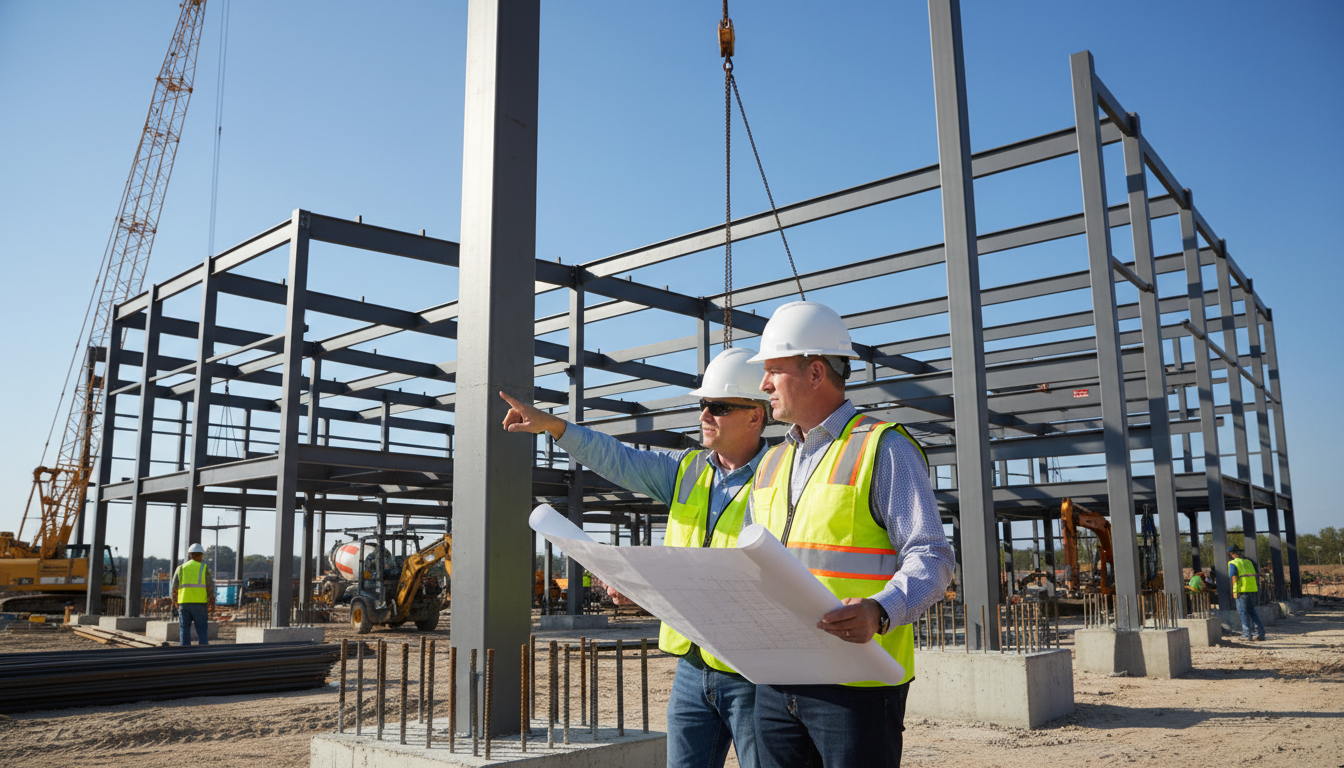
The structural engineer on a commercial new construction project is involved long before ground breaks and long after the concrete is poured. For developers, owners, and general contractors who haven’t worked with a structural PE from the beginning of a project, the scope of that involvement is often surprising. The engineer isn’t just drawing beams — they’re selecting a structural system, running lateral and gravity analysis, producing stamped construction documents, answering requests for information during construction, and signing off on the as-built work.
This guide walks through the full arc of commercial structural design — what happens at each phase, who the engineer coordinates with, and what owners should expect from a good PE firm on a ground-up commercial project. If you’re planning a new build and trying to understand where your structural engineering fees are going, this is the roadmap.
Every commercial new construction project in the United States requires engineered structural design. The International Building Code (IBC), adopted with amendments in every state we work in — Georgia, Florida, South Carolina, North Carolina, and Tennessee — explicitly requires engineered design for commercial occupancies. There is no prescriptive path for commercial buildings the way there is for simple single-family homes under the IRC.
That means from day one, the project has an “engineer of record” — a licensed structural PE whose stamp will ultimately appear on the drawings submitted for permit. The engineer of record carries professional liability for the structural design and is responsible for confirming that the final built condition matches the stamped drawings. Nothing about commercial structural engineering is optional.
The corollary: if you’re planning a commercial project without a structural engineer engaged, you’re planning a project that won’t get permitted. Get the engineer involved early — during schematic design, not after the architect finishes drawings — and the rest of the project runs more smoothly.
A typical commercial new construction project moves through five major phases. The structural engineer is involved in all of them.
At schematic design, the project is an idea. The architect has sketched massing, floor plates, and basic organization. The structural engineer’s job at this phase is to:
Schematic design is often underestimated by owners. It’s the phase where the project’s structural DNA is set. Changes after SD become increasingly expensive as the design develops.
Design development takes the SD concept and starts turning it into an engineered system. The structural PE:
DD is where the design starts to look like something buildable. It’s also where the engineer catches issues — beams that won’t fit, columns that conflict with architectural intent, foundations that need to grow to carry the load. Fixing these issues in DD is much cheaper than fixing them later.
Construction documents are the deliverable the building department and contractor care about. CDs are the stamped, sealed drawings and specifications that a PE signs and that become the basis for permitting, bidding, and construction. At this phase, the structural engineer:
A complete set of structural CDs for a mid-size commercial project typically runs 20–60+ sheets. For a complex building, it can exceed 150 sheets.
Once CDs are complete, the project goes through two parallel tracks:
This phase is often invisible to owners but can take weeks or months depending on the jurisdiction. Atlanta, Miami, Nashville, and Charlotte all have their own review timelines. Engineers who know the local reviewers tend to get faster approvals.
Once the permit is issued and construction starts, the engineer’s role shifts to construction administration. CA is the phase where a lot of engineers get underpaid — it can take significantly more time than owners expect. The engineer:
CA on a commercial project typically runs the duration of construction — 6 to 18+ months depending on project size.
Experienced structural engineers bring value beyond just “drawing beams.” A few of the things a good PE firm adds to a commercial new construction project:
If you’re planning a commercial new build, a few practical suggestions:
How long does structural design take on a commercial new build?
It depends heavily on project size and complexity. A small mid-size commercial building (two-story, 20,000 sq ft) may move from SD through CDs in two to four months. A larger or more complex building can take six months or more. Add permit review and bidding on top of that.
Who selects the structural system — the architect or the engineer?
Both, collaboratively. The architect starts with form and function; the engineer evaluates which structural systems work for that form and proposes tradeoffs. Good design is a dialogue. The final call usually comes down to cost, schedule, and constructibility.
What’s included in a structural engineering fee for new construction?
Typically: schematic design participation, design development calculations and drawings, construction documents (stamped), specifications, response to permit review comments, and some amount of construction administration. Confirm in writing what’s included — especially CA scope, which is often the biggest gray area.
Do I need a structural engineer during construction, or only during design?
Both. The engineer of record remains engaged during construction to answer RFIs, review shop drawings, perform field observations, and issue any necessary design clarifications. A new building cannot receive its certificate of occupancy without the engineer of record’s sign-off.
What if something doesn’t match the drawings in the field?
Field conditions rarely match drawings exactly. Small deviations are typical and handled via RFIs or supplemental sketches. Major deviations — missing connections, substituted materials, undersized members — require the engineer to review and either accept, reject, or require remediation.
Can one engineer handle a multi-state commercial project?
Only if they’re licensed in every state the project touches. Multi-state projects require PE licensure in each jurisdiction where the work is performed. Firms with broad multi-state coverage (like our 28-state footprint) avoid the delay and coordination cost of sub-consulting separate engineers per state.
What happens if the project budget comes in high after structural design is complete?
This is a common situation. The engineer can work with the team on value engineering — simplifying connections, reducing steel tonnage, switching systems, or rethinking spans. Value engineering after CDs is more expensive than designing efficiently from the start, which is why early structural engagement pays off.
Planning a commercial new build in the Southeast? Strut Engineering & Investment, Inc. provides structural design, construction documents, and construction administration for commercial projects across Georgia, Florida, the Carolinas, Tennessee, and beyond. Contact our team for a scoped proposal.