

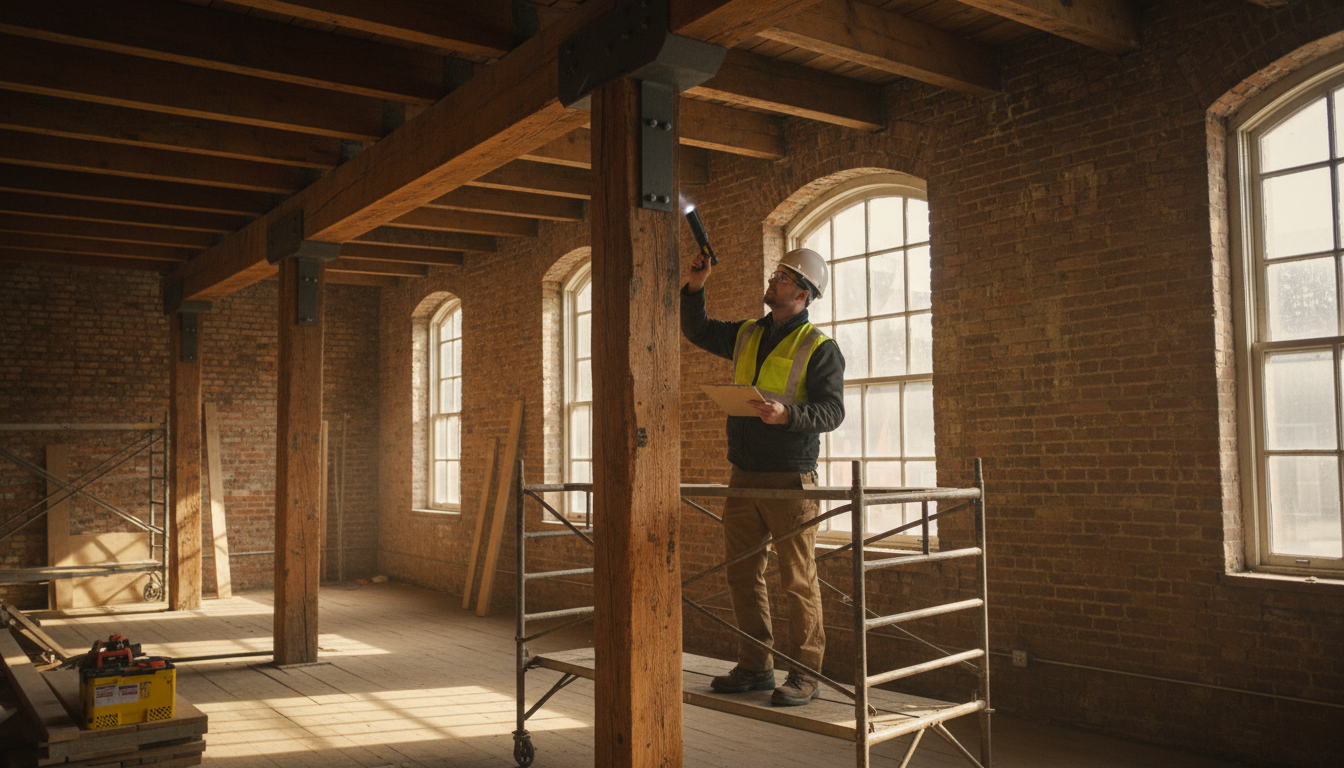
Structural rehabilitation is the engineering discipline of extending, strengthening, modifying, or restoring existing buildings. It’s very different work from designing new construction — and in many ways more challenging. When you design a new building, you start from a blank page. When you rehabilitate an existing one, you start with whatever was built, whatever has happened to it since, and whatever drawings (or lack of drawings) exist to document it.
This guide explains how structural engineers approach rehabilitation projects, what kinds of work fall under “rehabilitation,” why existing buildings are harder than new ones, and what property owners and developers should expect from a competent rehabilitation engineer. If you’re considering a renovation, addition, change of use, or strengthening project on an existing building, this is the foundation you need.
“Rehabilitation” is a broad umbrella that covers a number of different project types. All of them involve existing structures and all of them require structural engineering judgment. The most common:
What all of these have in common: you’re not starting from scratch. The building already exists. And the building has its own story.
New construction is a blank canvas. You design the structure to carry the loads you know about. You specify the materials. You supervise the build. Everything is known.
Existing buildings are almost the opposite. Here’s what you’re up against on a typical rehabilitation project:
The ideal situation is a complete set of original architectural and structural drawings, as-builts reflecting any subsequent modifications, permit records, and inspection reports. That almost never exists. What you typically get is:
The engineer has to verify what’s actually there — often by opening walls, probing foundations, taking material samples, and measuring member sizes in person.
Original concrete strength? Unknown unless tested. Original steel grade? Unknown unless coupon samples are taken. Wood species and age? Unknown. Masonry mortar type? Unknown. For older buildings, the engineer may need to take physical samples and have them tested in a lab before any analysis can proceed.
Every existing building has some level of deterioration. Concrete carbonates. Rebar corrodes. Wood rots and is attacked by insects. Masonry spalls. Steel rusts. Water infiltration causes damage that may or may not be visible. Part of the rehabilitation engineer’s job is characterizing the current condition of the materials, which directly affects how much load the existing members can carry.
Buildings designed to 1960s code weren’t designed for today’s loads or today’s requirements. When you rehabilitate, you often have to bring the building up to current code — at least for the areas affected by the work. Engineers work with jurisdictional authorities to determine which code applies (existing building code, “triggered” provisions, or full current code) and what the upgrade scope becomes.
Every existing building is different. What worked on the last rehabilitation project may not work here. Existing conditions force creative engineering — reinforcement details that work around existing elements, phased construction to keep the building functional during work, custom connections, and unusual solutions.
A well-run rehabilitation project moves through a sequence similar to new construction, but with important differences in the early phases.
Before any design work happens, the engineer characterizes what’s already there. This typically involves:
This phase can take weeks on a complex building. It’s also where the engineer catches things that will surprise the project team — missing connections, substandard materials, prior modifications, code violations, hidden damage. Better to catch them now than during construction.
With the existing conditions documented, the engineer models the building and analyzes its current load-carrying capacity. Key questions:
This analysis determines what can be preserved, what needs to be reinforced, and what has to be replaced.
Now the engineer designs the rehabilitation itself. Depending on the project, this might include:
One of the biggest challenges is designing reinforcement that doesn’t destroy the thing you’re trying to save. Reinforcement schemes in historic buildings, for example, have to preserve visible character. On adaptive reuse projects, the reinforcement usually has to fit within the finished architecture.
Many rehabilitation projects can’t be built all at once. You may need to keep the building partially occupied, keep it weather-tight, or work around access constraints. The engineer designs:
Temporary works are often more complex than the permanent work. On some projects, the temporary shoring design is the majority of the engineering effort.
Like new construction, rehabilitation projects require the engineer’s involvement throughout construction. What’s different: surprises are more common. The contractor opens up a wall and finds something nobody knew was there. The engineer has to respond quickly — often with a design revision issued as a supplemental sketch.
Rehabilitation projects typically require more frequent site visits than new construction because of the higher rate of unexpected field conditions.
Every region has its own rehabilitation challenges. In our practice across the Southeast:
Historic brick and masonry buildings in Atlanta, Nashville, Savannah, and Charleston. Unreinforced masonry, aging lime mortar, missing wall ties, and water damage are common. Adaptive reuse projects often require full-building strengthening.
Mid-century commercial buildings from the 1950s–1970s. Common issues include inadequate lateral systems by modern standards, deterioration of post-tensioned concrete, and original designs that didn’t anticipate today’s building use or equipment loads.
Coastal buildings in Miami, Tampa, Key West, and Charleston with salt-induced concrete deterioration. Rebar corrosion expands and cracks the surrounding concrete — common in parking garages, seawalls, and exposed concrete structures.
Foundation settlement and clay soil damage across Georgia and North Carolina. Buildings that have moved over decades now need foundation rehabilitation. See our guide to foundation settlement.
Storm-damaged structures post-hurricane. Wind, water, and debris impact damage are the bread and butter of forensic engineering and rehabilitation in Florida and the coastal Carolinas.
Some situations where you should be calling a rehabilitation engineer, not just any structural engineer:
Rehabilitation engineering is a skill set that develops with experience. Not every structural engineer is comfortable working with incomplete drawings, unknown materials, and field surprises. Ask the firm about their rehabilitation portfolio specifically — not just their general structural experience.
How is rehabilitation different from new construction engineering?
New construction starts with a blank slate — you design to the loads you need. Rehabilitation starts with an existing building of unknown condition and has to work with (or around) what’s already there. Rehabilitation requires more investigation, more judgment, more field time, and more flexibility than new construction engineering.
Do I need existing drawings to rehabilitate a building?
Having drawings helps, but it’s not required. Experienced rehabilitation engineers can work without them — they just have to do more field investigation up front. The cost of the investigation is typically much lower than the cost of guessing wrong.
Can a rehabilitation project always save the existing building?
Not always. Some buildings are beyond economical repair — the cost of strengthening exceeds the cost of demolition and new construction. A good rehabilitation engineer will tell you early in the process when that’s the case. It’s not a failure of engineering; it’s sound judgment.
What building code applies to a rehabilitation project?
Most jurisdictions use the International Existing Building Code (IEBC) or state equivalents, which have provisions for repairs, alterations, additions, and change of occupancy. Whether you have to bring the full building up to current code depends on the scope of work and the jurisdiction.
How long does a rehabilitation project take?
Design timelines vary with complexity. Simple projects (a wall removal, a single reinforcement) can move through design in a few weeks. Complex adaptive reuse or full-building rehabilitation projects take months of design plus many more months of construction. Plan for surprises.
Is rehabilitation cheaper than new construction?
Sometimes yes, sometimes no. Rehabilitation can be cheaper when the existing building has substantial salvageable structure and shell. It can be more expensive when hidden conditions force extensive reinforcement, or when historic preservation constraints limit what you can do. The only way to know is to have a qualified engineer evaluate the building first.
Do historic preservation projects require a different engineer?
Yes, in most cases. Historic preservation requires familiarity with historic materials (limestone, brick, heavy timber, cast iron), an understanding of Secretary of the Interior’s Standards, and experience with preservation review authorities. Not every structural engineer is comfortable in that world.
Have an existing building that needs structural rehabilitation? Strut Engineering & Investment, Inc. provides existing conditions assessment, rehabilitation design, and construction administration for renovations, adaptive reuse, additions, and modifications across the Southeast. Explore our structural rehabilitation services.
Related service: A second-story addition asks an existing structure to carry loads it was never designed for — rehabilitation in the truest sense. See our second-story addition structural engineering services and the engineering process behind them.