


Mastering Atlanta’s building codes is your key to a seamless construction journey, sidestepping costly delays and compliance headaches. Whether you’re an architect, developer, contractor, or homeowner, understanding the nuances between residential and commercial regulations is paramount. This guide breaks down the critical differences in structural criteria, fire safety mandates, accessibility standards, energy efficiency requirements, permit and inspection processes, the vital role of structural engineers, state and local code frameworks, zoning implications, specialized codes, and how to handle violations. By leveraging Strut Engineering’s deep expertise in Atlanta’s specific codes, you’ll boost project safety, slash risks, dodge fines, and secure approvals faster.
Atlanta’s residential and commercial building codes stem from distinct chapters within the Georgia State Minimum Standard Codes, each tailored to different structural loads, occupancy types, life-safety needs, and energy performance goals. Residential codes focus on single-family and multi-family dwellings with lighter occupant loads and simpler egress paths. Commercial codes, however, cater to higher occupant densities, specialized functions, and more demanding performance criteria. For example, renovating a townhouse falls under the International Residential Code (IRC) with state amendments, while designing an office tower adheres to the International Building Code (IBC), augmented by local fire and accessibility rules.
The Georgia State Minimum Standard Codes, including the International Building Code (IBC) and the International Residential Code (IRC), are the mandatory building standards across Georgia. These codes are periodically updated, with the latest editions taking effect on January 1, 2025.
This foundational document establishes the mandatory building codes that govern construction in Georgia, forming the basis for Atlanta’s specific code requirements.
This comparison highlights how distinct occupant profiles, structural demands, fire separation needs, accessibility mandates, and energy code pathways necessitate separate requirements for residential and commercial projects. Next, we’ll delve deeper into the structural differences.
Residential structures in Atlanta are designed to handle live loads of 40 psf and wind loads specified by IRC wind speed zones, typically utilizing light-frame wood or light-gauge steel construction. Commercial buildings, however, face significantly higher live loads—ranging from 50 psf for offices to 100 psf for retail spaces—and demand more robust materials like cast-in-place concrete or structural steel to ensure greater rigidity and longevity. Here are the primary structural distinctions:
Residential framing prioritizes cost-effective load paths for smaller footprints, allowing structural engineers to optimize members for lighter loads. In contrast, commercial engineers tackle complex load combinations, a factor that directly influences fire-safety regulations, which we’ll explore next.

Fire safety provisions under the International Residential Code focus on safeguarding occupants in homes through measures like smoke alarms, one-hour separation walls for townhouses, and safety features for two-story atriums. The International Building Code, however, mandates stricter compartmentalization with rated fire walls, sprinkler systems in high-rise occupancies, and specific fire-resistance ratings for structural components. Key fire code differences include:
By differentiating fire compartment sizes, required ratings, and alarm systems, Atlanta’s fire safety codes ensure varying levels of protection based on occupancy type. This leads us to a closer examination of accessibility and egress distinctions.
Residential accessibility requirements, governed by the Georgia Accessibility Code, primarily apply to multi-family dwellings with common areas and public entrances, focusing on features like entrance ramps and accessible units. Commercial codes, conversely, mandate full ADA compliance, encompassing everything from the grading of accessible routes and door hardware reach ranges to accessible restroom fixtures. Egress specifications also diverge significantly, with differences in exit width, the number of required exit paths, and emergency signage between single-family homes and commercial occupancies. The core differences include:
The Georgia Accessibility Code, aligned with the 2010 ADA Standards for Accessible Design, sets the minimum statewide standards for accessibility in covered government buildings, public facilities, and structures undergoing construction or renovation after July 1, 1997. Its purpose is to guarantee accessibility for individuals with disabilities.
The Georgia Accessibility Code, which mirrors the ADA Standards, is actively enforced in Atlanta to ensure that buildings are accessible to everyone.
These accessibility and egress frameworks clearly demonstrate how occupant welfare and evacuation capacity drive more stringent standards for commercial projects. This naturally leads us into the energy provisions that further differentiate these code systems.
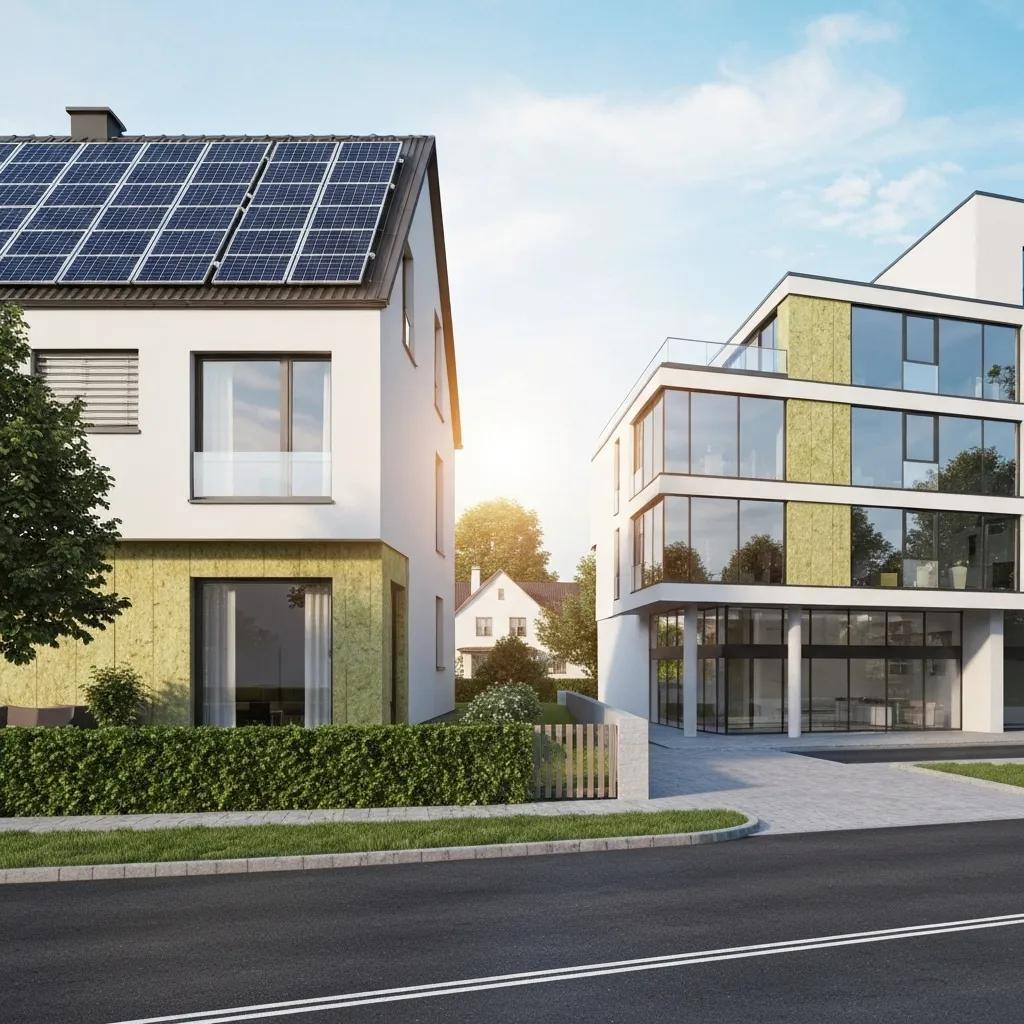
Energy conservation in Atlanta homes is guided by the International Energy Conservation Code (IECC) Residential provisions, which specify insulation R-values, furnace efficiency, and window U-factors. Commercial buildings, on the other hand, must comply with the IECC’s commercial chapter, offering flexible trade-off, performance, or prescriptive compliance paths that address the building envelope, HVAC systems, and lighting power densities.
The International Energy Conservation Code (IECC) outlines the minimum energy efficiency requirements for commercial buildings. It provides prescriptive and performance-based compliance options covering the building envelope, HVAC systems, and lighting power densities.
The IECC is a critical standard used in Atlanta to ensure commercial buildings achieve their energy efficiency targets.
By employing different compliance methodologies—from straightforward prescriptive R-value tables in residential codes to complex energy modeling for commercial projects—Atlanta’s codes ensure that each building type meets its energy objectives without unduly burdening developers. This discussion on energy naturally transitions into the permitting and inspection processes that enforce these standards.
Atlanta’s online permit portal offers a streamlined process for homeowners undertaking one- and two-family dwelling projects. Commercial permits, however, demand extensive documentation, including detailed plans, third-party reviews, and multi-disciplinary approvals, reflecting the greater scale and complexity of commercial construction. Residential permits are often issued within days for minor projects, whereas commercial approvals can take weeks, involving thorough reviews of structural, fire, zoning, and environmental aspects. Understanding each pathway is crucial for reducing approval times and ensuring code compliance from the very beginning.
<… remaining content …>
Georgia’s State Minimum Standard Codes adopt the 2018 editions of international codes, enhanced with state-specific amendments. Atlanta further enforces its own local provisions, addressing urban stormwater management, tree protection, and high-rise fire safety. These layered regulations ensure that buildings meet both statewide benchmarks and local priorities.
Residential structures in Atlanta are subject to the following codes:
The International Residential Code (IRC) sets forth minimum regulations for one- and two-family dwellings and townhouses up to three stories in height. It encompasses all building, plumbing, mechanical, fuel gas, energy, and electrical provisions pertinent to these residential types.
The IRC is a cornerstone of the Georgia State Minimum Standard Codes and is applied in Atlanta to ensure the safety and integrity of residential construction.
State amendments refine criteria for crawlspace vents, allowable framing heights, and mechanical ventilation, adapting national standards to Georgia’s unique climate and terrain.
Commercial projects in Atlanta must comply with:
The International Building Code (IBC) is a model building code developed by the International Code Council (ICC). Widely adopted across the United States and internationally, it addresses health and safety concerns for buildings through a combination of prescriptive and performance-based requirements.
The IBC is a fundamental component of the Georgia State Minimum Standard Codes and is utilized in Atlanta to ensure the safety and compliance of commercial structures.
Local amendments address specific concerns such as historic districts, stormwater control, and tree conservation, requiring designers to integrate environmental and community protections alongside standard code compliance.
The Georgia Department of Community Affairs (DCA) plays a crucial role by publishing state amendments to the International Codes, issuing official interpretations, and ensuring consistent statewide enforcement. DCA’s model codes serve as the baseline for municipal adoption, and its technical bulletins provide clarity on ambiguous provisions, ensuring that local jurisdictions apply uniform requirements across the state.
Staying informed about these amendments is essential for builders and engineers to avoid costly re-submissions and field modifications. This knowledge smoothly transitions us to the zoning laws that further shape design requirements.
Atlanta’s zoning ordinances dictate land use, building height, density, and setbacks, indirectly influencing building code compliance by defining the permissible building envelopes and site configurations. Designers must first satisfy zoning requirements before addressing building code specifics, ensuring that structures harmoniously fit within neighborhood contexts and align with municipal development goals.
The City of Atlanta is organized into specific zones or districts that govern the physical development of land and restrict property uses. These zoning districts also regulate critical attributes such as the height, size, and placement of buildings on a lot, the density at which buildings can be constructed, and the number of parking spaces required for each new building.
Zoning laws in Atlanta significantly influence building design and code compliance by establishing the parameters for allowable building envelopes and site configurations.
Atlanta’s primary residential districts, ranging from R-1 through R-5, include:
Setbacks, lot coverage limits, and impervious surface restrictions directly influence foundation placement and the overall structural footprint, thereby shaping the design and size of code-compliant structures.
Commercial zones, designated as C1 through C5, define specific development parameters, including:
Maximum floor area ratio (FAR), building height limitations, and required parking provisions mandated by zoning ordinances directly influence the selection of structural systems and the calculation of vertical loads, effectively linking zoning constraints with building code solutions.
The Floor Area Ratio (FAR) determines the total allowable building area in proportion to the lot size. For instance, a 0.5 FAR on a 10,000 sq ft lot permits a maximum of 5,000 sq ft of building area. Higher FARs in commercial centers enable larger building footprints, necessitating advanced structural systems to manage increased loads, while lower FARs in residential districts encourage smaller, more efficient designs.
Official zoning maps, ordinance texts, and detailed district definitions are readily accessible through the City of Atlanta’s Planning and Community Development department portal. This resource provides interactive maps, concise district summaries, and contact information for staff members who can clarify zoning classifications and overlay requirements.
Atlanta builders must integrate multiple code frameworks—including NFPA life-safety standards, ADA and Georgia Accessibility Code mandates, and IECC energy provisions—all tailored to specific occupancy types. This comprehensive approach ensures occupant safety, universal access, and conservation goals are met.
The NFPA 101, Life Safety Code, provides essential guidelines aimed at minimizing the destructive impacts of fire, smoke, and toxic fumes. It addresses the construction, protection, and occupancy features necessary to reduce the danger to life from fire and related hazards in both new and existing structures.
NFPA 101 is a critical code for ensuring fire safety and is referenced within Atlanta’s broader building code regulations.
Commercial buildings are required to provide accessible routes, entrances, parking, restrooms, and boarding areas in accordance with the ADA Standards for Accessible Design and the Georgia Accessibility Code. Designers must specify:
The ADA Standards for Accessible Design, alongside Title II and Title III regulations, detail the specific requirements for buildings and facilities to be physically accessible to individuals with disabilities. These standards apply to newly constructed buildings, alterations, and efforts to remove barriers in existing structures.
The ADA Standards are rigorously enforced in Atlanta to guarantee accessibility in all commercial buildings.
Energy officials meticulously review compliance reports that verify building envelope U-factors, HVAC system efficiencies, and lighting power densities. Many commercial projects opt for energy modeling under the IECC performance path or pursue third-party green building certifications, such as LEED. Residential builders typically follow IECC prescriptive tables and rely on third-party inspection reports to confirm insulation and duct leakage requirements, ensuring that both building types achieve their designated energy conservation goals.
Atlanta’s code enforcement system relies on the Office of Buildings to conduct inspections, issue violation notices, and oversee remediation plans designed to bring structures into compliance. Prompt resolution of code infractions is essential for restoring safety and legality, protecting property owners from potential fines, liens, or even forced demolition orders.
The City of Atlanta Office of Buildings is the primary authority responsible for enforcing building codes. They issue stop-work orders and coordinate with fire and zoning departments when violations occur. Code officers investigate complaints, conduct field audits, and issue official violation notices that clearly outline the required corrective actions.
Property owners or occupants can report violations through the city’s dedicated online portal. Following a site investigation, the Office of Buildings issues a notice of violation, detailing the deficient conditions and specifying compliance deadlines. Responsible parties must then submit repair plans, secure necessary permits, complete the corrective work, and schedule follow-up inspections to verify compliance.
Property owners have the right to appeal violation determinations. Appeals must be submitted to the City of Atlanta’s Building Code Board of Appeals within 30 days of receiving the notice. The board will review all submitted evidence, hear testimony from relevant parties, and can either uphold, modify, or dismiss the violation, ensuring a fair process and due enforcement.
Frequent code infractions often stem from:
Recognizing these potential pitfalls and engaging Strut Engineering for early-stage plan reviews can effectively prevent violations and pave the way for a smooth project completion.
Navigating Atlanta’s intricate building code landscape requires a meticulous approach to residential and commercial provisions, precise coordination of permits, expert structural engineering insights, and proactive zoning compliance. This diligence is key to delivering safe, efficient, and fully code-conforming structures. Partnering with seasoned professionals ensures that your project meets every requirement, from foundational elements to final occupancy, upholding the highest standards of safety and performance.