

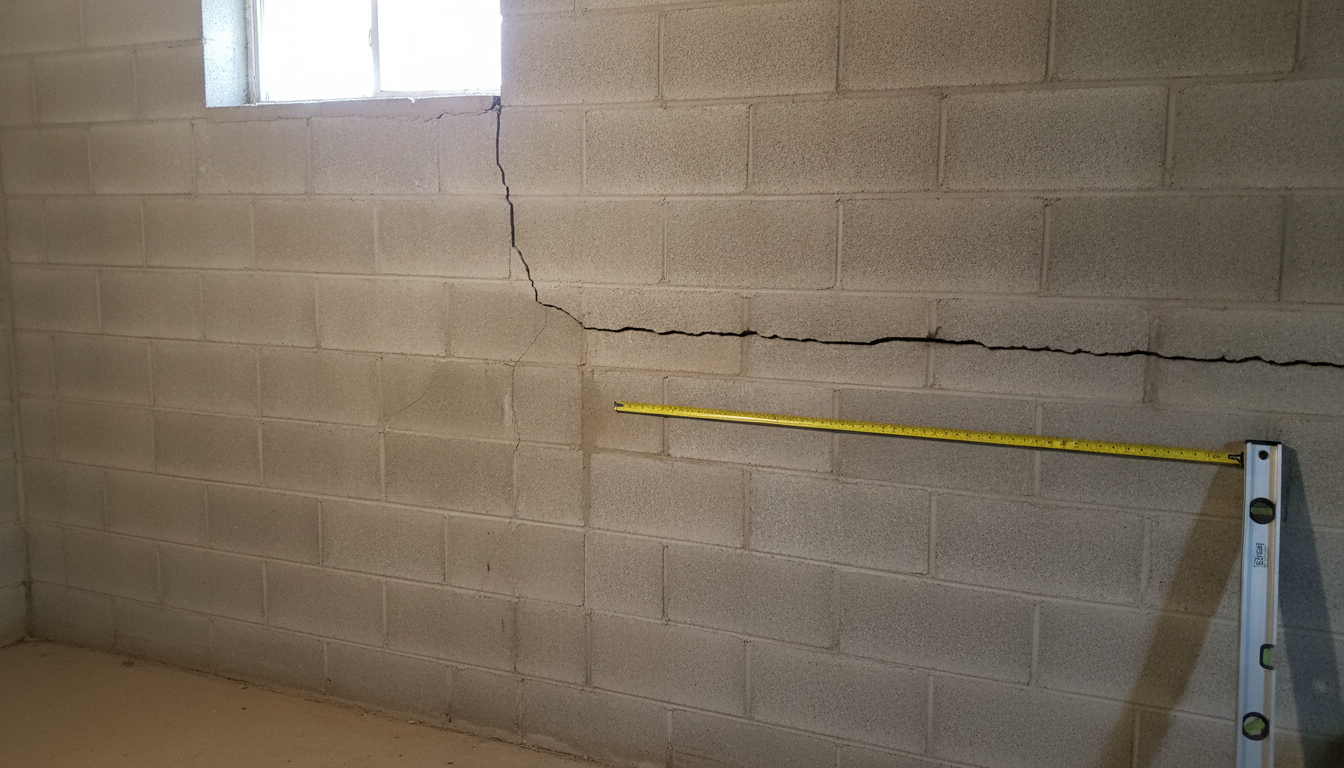
Most foundation cracks are not emergencies. A horizontal crack in a foundation wall is the exception worth taking seriously.
Vertical cracks usually come from concrete shrinking as it cures, or from minor settlement. Horizontal cracks tend to come from something else entirely: soil on the outside of the wall pushing inward harder than the wall was designed to resist. That is a structural load problem, not a cosmetic one, and it can get worse over time. If you have found one, the right next step is an evaluation by an independent foundation repair structural engineer, ideally before anyone quotes you a repair.
This guide explains what a horizontal crack usually means, how to judge how urgent yours is, and what the repair options look like.
A basement or foundation wall has two jobs. It carries the weight of the house down to the footing, and it holds back the soil around it. The first job pushes straight down. The second pushes sideways.
Walls are generally very good at the first job. Concrete and concrete block are strong in compression. They are much weaker when bent, and lateral soil pressure bends the wall. The wall is supported at the bottom by the footing and the slab, and at the top by the floor framing. Push on the middle and it bows inward, like a plank spanning between two supports. The crack opens where the bending is greatest, which is why horizontal cracks often appear somewhere between one-third and halfway up the wall.
So a vertical crack generally says “something moved a little.” A horizontal crack is more likely to say “something is pushing on this wall, and the wall is losing.”
Soil does not push evenly in every season. Several conditions increase the load on the wall:
Wet soil is heavier than dry soil, and water itself adds pressure against the wall. Poor grading, clogged or short downspouts, and gutters that overflow next to the foundation are some of the most common contributors. Water problems also damage framing and other materials over time. Our article on how water damage affects structural integrity covers that side of it.
Clay soils swell when they get wet and shrink when they dry. Each swelling cycle can push the wall inward, and the soil does not always pull it back when it shrinks. Much of the Southeast, including the red clay around Atlanta and the Carolina Piedmont, has clay-rich soils. We cover the local version of this problem in foundation problems in Atlanta homes.
In colder climates, frozen soil expands and can push on shallow walls. This matters less across most of the Southeast, but it is a real factor in parts of Tennessee, northern Georgia, and the Northeast.
Heavy equipment, a driveway, a parked vehicle, or a structure built close to the foundation adds load to the soil, and the soil passes some of that sideways into the wall.
Some walls were never designed for the soil height against them. Block walls without enough reinforcement, or basements backfilled before the floor framing was in place to brace the top, are more vulnerable from day one.
Not every horizontal line is equally serious. Here is a practical way to sort what you are seeing, with a caveat: this is a guide to how urgently to call an engineer, not a substitute for one.
| What you see | Level of concern |
|---|---|
| Thin horizontal crack, wall looks straight, no change over months | Moderate. Get it evaluated and monitored |
| Horizontal crack along a block mortar joint with stair-step cracks at the ends | High. Often an early sign of a wall starting to bow |
| Crack you can fit a coin into, or one that is visibly getting wider | High. Schedule an engineer promptly |
| Wall visibly bowing, leaning, or bulging inward | High. Schedule an engineer promptly |
| Blocks shifted out of line, or the top of the wall sliding inward | Urgent. Call an engineer right away |
| Water seeping through the crack | Elevated. Water is likely part of the cause |
A few other signs push the urgency up: doors or windows near the wall that have started sticking, gaps opening where the wall meets the floor framing, or new cracks in the walls upstairs. Those overlap with the broader warning signs of structural damage and suggest the movement is affecting more than one part of the house.
While you wait for an assessment, you can collect useful information:
Bring all of this to the engineer. It helps tell an active problem from an old one.
The material changes how the crack looks.
In a concrete block (CMU) foundation, horizontal cracks usually follow a mortar joint, since the joints are the weakest line in the wall. The classic pattern is a long horizontal crack near mid-height with stair-step cracks running diagonally toward the corners. Block walls can also shear, where one course of block slides inward relative to the course below it.
In a poured concrete foundation, horizontal cracks are less common because poured walls tend to be stronger in bending. When one does appear, it deserves the same seriousness.
What the repair should be depends on how far the wall has moved, whether it is still moving, and what is causing it. That is exactly what the engineering assessment determines. The common options include:
If drainage is driving the pressure, fixing grading, extending downspouts, or adding drainage is often part of any repair. Sometimes, for a wall with minor movement, it is the main part. A repair that ignores the cause tends to come back.
Steel beams installed vertically against the inside face of the wall, anchored at the floor and the framing above, stop further inward movement. Bracing is a common choice for walls that have bowed modestly.
Anchors placed in the soil outside the wall, connected through the wall with steel rods and interior plates, hold the wall back against the soil. Some systems allow gradual tightening over time.
Carbon fiber straps bonded to the inside of the wall add bending strength. They suit walls with limited movement, and the engineer needs to confirm the wall is a good candidate.
When a wall has moved too far or the blocks have shifted out of line, the right answer can be to excavate the outside, remove the soil pressure, and straighten or rebuild the wall. It is the most disruptive option and is generally saved for severe cases.
Each option has limits, and repair companies often favor the system they install. That is why an engineer’s independent repair design matters. It defines what the wall actually needs, and then any qualified contractor can price the same scope.
A foundation repair company can be a good partner for the construction. But the diagnosis and the sale should not come from the same place. An independent structural engineer has no product to sell, so the recommendation follows the structure: sometimes a smaller repair than you were quoted, sometimes a different method, and sometimes a conclusion that a crack is old and stable.
You also get a sealed document. Building departments often require engineered drawings for structural foundation repairs. Buyers, lenders, and insurers put far more weight on a licensed engineer’s report than on a sales estimate. And after the work is done, a post-repair verification letter documents that the repair was installed properly. That letter is worth keeping for resale.
If you are buying a home with a horizontal crack in the basement, an engineer’s evaluation should be part of your due diligence. It often makes sense to fold it into a full residential structural inspection. If you are wondering about fees, see what a structural engineer inspection costs.
For cracking that comes from the house settling rather than from soil pressure, see our companion guide on foundation settlement causes and signs.
It usually is more serious than a vertical crack, because it often means soil pressure is bending the wall inward. Not every horizontal crack means the wall is failing, but each one deserves an evaluation by a structural engineer, and cracks that are widening or paired with bowing should be looked at promptly.
Sealing can keep water out, but it does not address the soil pressure that likely caused the crack. If the wall is still moving, a sealed crack will often reopen. Have an engineer determine the cause and whether structural repair is needed before relying on sealant.
Hold a long level or straight board vertically against the wall. A gap near the middle of the wall suggests bowing. Other signs include horizontal and stair-step cracks together, blocks out of line, and gaps where the wall meets the floor framing above.
Vertical cracks are commonly caused by concrete shrinkage or minor settlement and are often not structural. Horizontal cracks are more often caused by lateral soil pressure, which bends the wall, and are more likely to require structural repair.
Start with an independent structural engineer. The engineer diagnoses the cause and defines the repair without selling a product. With a sealed repair design, you can get competitive bids from contractors who are all pricing the same work.
Common methods include fixing drainage, steel wall bracing, wall anchors, carbon fiber reinforcement, and in severe cases excavating and rebuilding the wall. The right choice depends on how far the wall has moved and what is causing it, which an engineering assessment determines.
A horizontal crack is the foundation telling you something is pushing on it. The sooner you understand what, the more repair options you keep. Strut E&I’s licensed structural engineers provide independent foundation assessments and sealed repair designs across Greater Atlanta and the Southeast.
Call (404) 480-5555 or contact our team to schedule an assessment, or browse our full range of structural engineering services.