

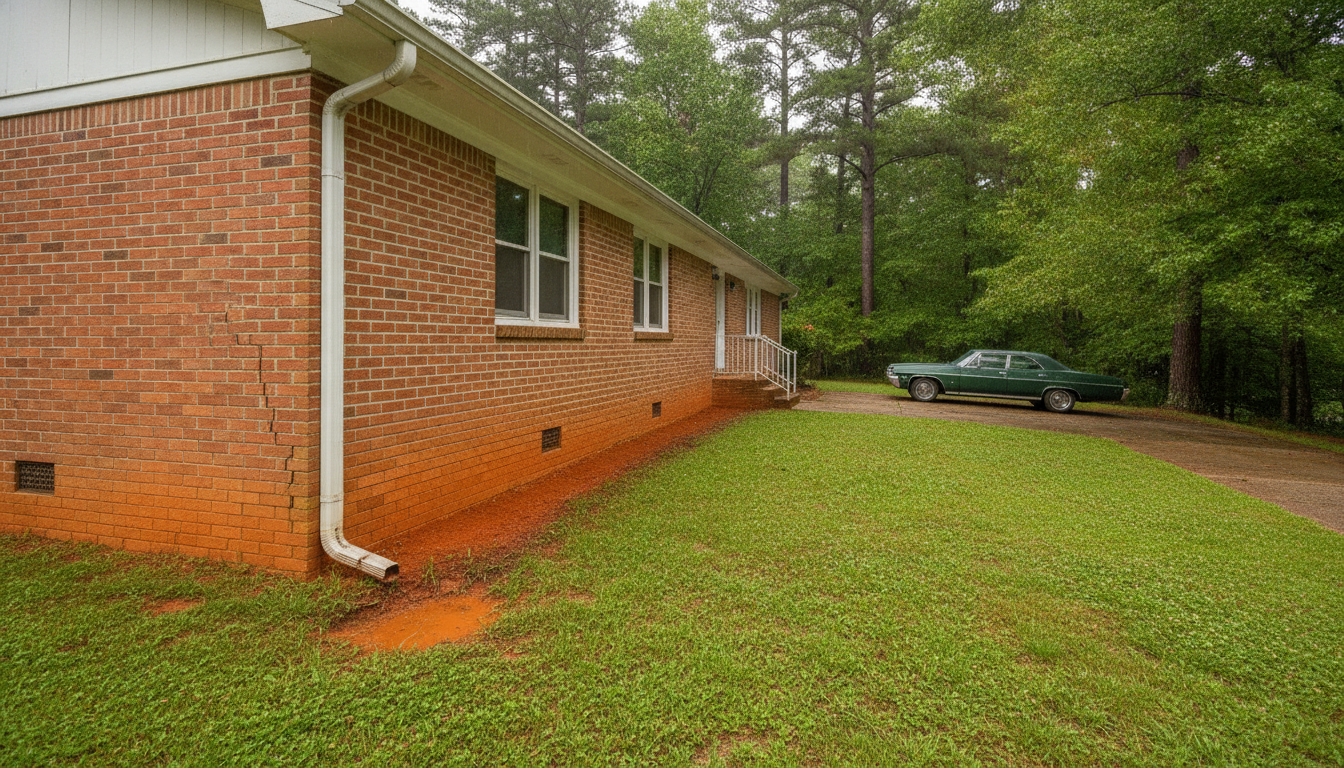
If you live in metro Atlanta, you already know the soil. It stains your shoes, your dog, and your driveway. That same red clay sits under almost every house in the region, and it plays a part in most of the foundation problems Atlanta homeowners call us about.
The clay itself is rarely the whole story, though. Most Atlanta foundation problems come from what happens to the soil: water that drains toward the house instead of away from it, fill that was never properly compacted, and long dry spells followed by heavy rain. Knowing which of those is at work under your house is the first step in fixing it. When the symptoms point to real movement, an independent foundation repair structural engineer can tell you what is happening and what the fix should be, before anyone sells you piers you might not need.
This guide explains how Atlanta’s soils behave, what the warning signs look like, and when to call an engineer instead of a repair company.
Most of metro Atlanta sits on the Georgia Piedmont. Over millions of years, the granite, gneiss, and schist bedrock under the region weathered in place into what geologists call residual soil. The upper layers are red and orange clays and silty clays. The color comes from iron oxides. Below that, there is often a layer called saprolite, which is rock that has weathered into soil but still shows the structure of the original rock.
Here is the point that surprises many people: Atlanta’s red clay is generally not the highly expansive clay you hear about in Texas or Colorado. It is rich in kaolinite, a clay mineral that swells and shrinks far less than the smectite clays that crack foundations in Dallas or Denver. That does not mean Atlanta soil never moves. It means the main causes of foundation problems here are usually different.
There are exceptions. Some pockets around the metro area do contain more reactive clays, and soils change from lot to lot. That is one reason a site-specific evaluation beats any general rule.
Water is the most common thread in the Atlanta foundation problems we see. Clay drains slowly. When rain falls faster than the soil can absorb it, water collects against the house, saturates the ground around the footings, and softens the soil they bear on.
Typical culprits:
Atlanta averages roughly 50 inches of rain a year, often in heavy bursts. A house with poor drainage gets tested over and over.
Even moderately reactive clay changes volume when its moisture content changes a lot. Metro Atlanta goes through dry summers and droughts followed by long, wet stretches. As the soil dries, it shrinks and pulls away from the foundation. When it gets soaked again, it softens and can swell slightly. Over years, that cycle can cause small, repeated movements, especially at corners and under parts of the house where moisture conditions differ, like near a big tree on one side or a leaking spigot on another.
Large trees close to the house add to this. Their roots draw water out of the soil during dry months, which can cause local shrinkage near the foundation.
Much of the growth in Alpharetta, Cumming, Kennesaw, and other suburbs happened on rolling land. Builders cut the high spots and filled the low ones to create flat lots. If that fill was placed in thick layers or not compacted properly, it keeps settling for years after the house is built.
Fill settlement often shows up in a pattern: one side or one corner of the house drops more than the rest, because that is the side built on fill while the other side sits on cut, undisturbed ground. This is one of the most common sources of foundation settlement in newer metro Atlanta subdivisions.
Hilly lots in Roswell, Sandy Springs, Dunwoody, and along the Chattahoochee often have retaining walls, steep backyards, and basements cut into the slope. Erosion can remove soil from under footings over time. Failing retaining walls can let soil move downhill, taking support with it.
Many older homes in Decatur, Kirkwood, East Atlanta, Grant Park, and other intown neighborhoods sit on brick piers in vented crawlspaces. These houses were built well for their time, but after 80 to 100 years, piers can tilt or deteriorate, wood sills and girders can rot from crawlspace moisture, and earlier repairs may not have been engineered at all. Sagging floors in these homes are often a framing and crawlspace problem more than a soil problem. The repair is different, which is why diagnosis matters.
For more on how residential construction in this region differs from commercial work, see our guide to residential structural design in Atlanta.
The type of foundation under your house changes what problems look like and how they get fixed.
| Foundation type | Common in | Typical problems |
|---|---|---|
| Crawlspace on brick or block piers | Older intown homes, mid-century ranches | Tilting piers, rotted sills and girders, sagging floors, moisture |
| Crawlspace with perimeter block wall | Many homes built from the 1950s on | Cracked block walls, settlement at corners, moisture |
| Full or partial basement | Sloped lots, newer suburban homes | Horizontal cracks, bowing walls, water intrusion |
| Slab on grade | Some newer homes, additions, garages | Slab cracks, settlement over fill, edge drop |
Not every crack is a foundation problem. Concrete and drywall crack as they shrink and as houses settle normally. The signs that deserve a closer look:
One sign by itself may be cosmetic. Several together, or any sign that keeps getting worse, points to movement worth investigating. For a broader checklist, see our post on warning signs of structural damage, and for a deeper look at why foundations sink, read foundation settlement: causes and signs.
When homeowners search for foundation repair in Atlanta, most of the results are repair contractors. Many are reputable. But it is worth understanding the difference in roles.
A foundation repair company sells and installs repairs: piers, wall anchors, crawlspace encapsulation, and similar products. Their inspections are usually free because the inspection is part of the sales process. The recommendation tends to match the products they install.
A structural engineer does not sell repair products. An engineer’s job is to determine what is moving, why, and what the right fix is, which might be a pier system, or might be regrading the yard and extending downspouts. The engineer’s findings are documented in a report and, when repairs are needed, a sealed repair design that any qualified contractor can bid on.
Call an engineer first when:
If you are in the middle of buying a home, a residential structural inspection before closing is far less disruptive than discovering a foundation problem after you own it.
A foundation evaluation from Strut E&I typically includes:
When repairs are needed, we prepare engineered repair drawings. That could mean helical or push piers, new footings, pier replacement in a crawlspace, wall reinforcement, framing repair, drainage changes, or some combination. Our structural rehabilitation team handles larger repairs that go beyond the foundation.
Many Atlanta foundation problems can be slowed or prevented with basic water management:
These steps cost little and address the cause behind most of the movement we see in metro Atlanta.
Strut E&I is a licensed structural engineering firm based in Atlanta. Our founder, Emad Badiee, holds a BS and MS in Civil-Structural Engineering from UAB, has more than 16 years of experience, and is licensed in 28 states and Washington, D.C. Every project is assigned a dedicated licensed structural engineer.
We evaluate homes across Greater Atlanta, including Marietta, Decatur, Alpharetta, Roswell, Sandy Springs, Dunwoody, Smyrna, and the surrounding communities, along with single-family homes throughout Georgia and the Southeast.
It can contribute, but usually not the way people expect. Atlanta’s red clay is kaolinite-rich and generally much less expansive than the clays in Texas or Colorado. Most foundation problems in Atlanta come from water and drainage, poorly compacted fill, erosion on sloped lots, and aging crawlspace construction, with some locally reactive soils in certain areas.
The most common are settlement at corners or along one side of the house, cracked brick and block walls, horizontal cracks and bowing in basement walls, and sagging floors in crawlspace homes. Settlement over poorly compacted fill is common in newer suburbs, while deteriorated piers and framing are common in older intown homes.
If you want an independent diagnosis, call a structural engineer first. An engineer does not sell repair products and will tell you what is causing the problem and what repair it needs, if any. If repairs are necessary, the engineer’s design lets you get comparable bids from repair contractors.
Small, hairline cracks in concrete and drywall are common and often cosmetic, caused by shrinkage and normal settling. Cracks that are wider than about a quarter inch, stair-step patterns in brick or block, horizontal basement wall cracks, or cracks that keep growing deserve an engineer’s evaluation.
Manage water. Extend downspouts away from the house, keep gutters clean, make sure the ground slopes away from the foundation, fix leaks near the house, and keep crawlspaces dry. Consistent soil moisture around the foundation is the goal.
Yes. We evaluate homes across metro Atlanta, including Marietta, Decatur, Alpharetta, Roswell, Sandy Springs, Dunwoody, and Smyrna, as well as throughout Georgia, the Carolinas, Florida, Tennessee, and our Northeast service areas.
Seeing cracks, sloping floors, or sticking doors? Strut E&I provides independent foundation evaluations and engineered repair designs for Atlanta homeowners. Learn about our foundation repair engineering services, call (404) 480-5555, or contact us to schedule an evaluation.
Related reading: many Atlanta homes sit on crawl spaces. See crawl space and pier-and-beam foundation repair.