

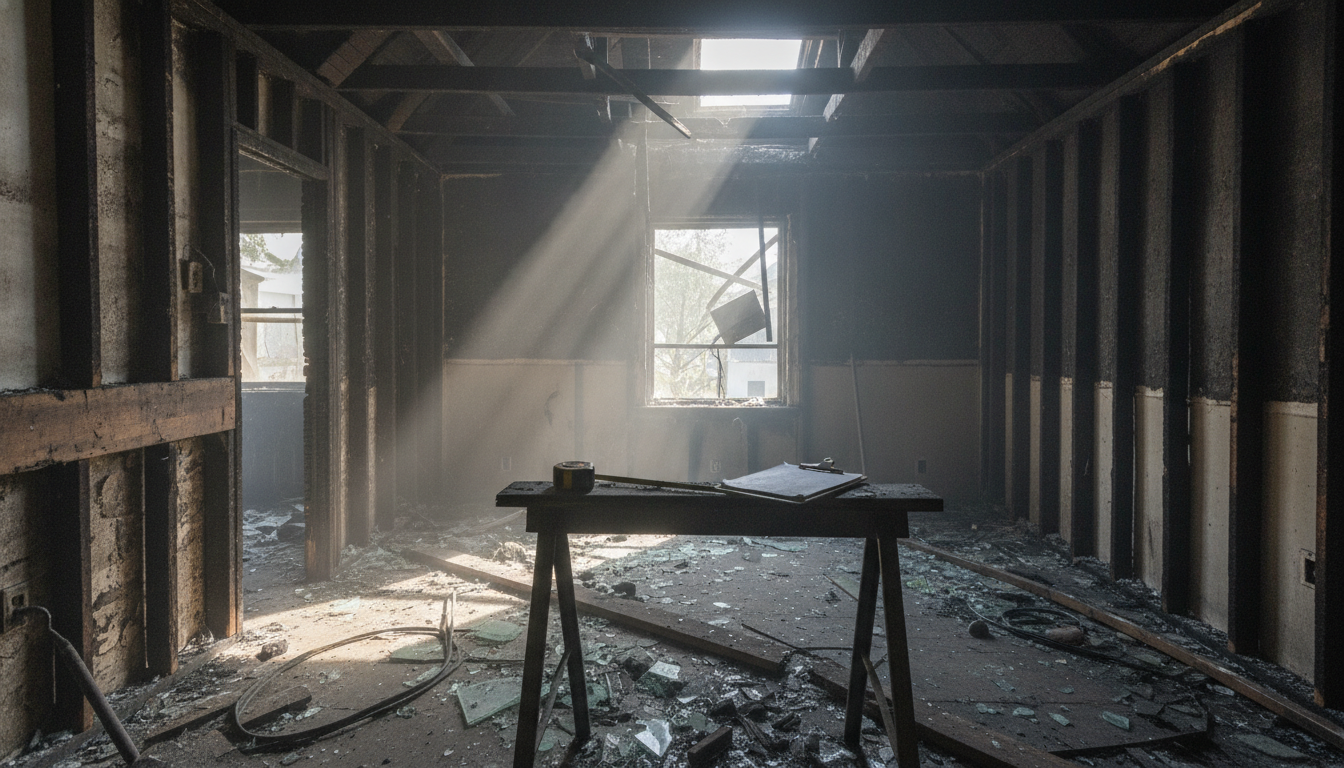
After a house fire, the first question everyone asks is whether the house can be saved. Owners want to know if they can go home. Adjusters need to know what the claim covers. Buyers looking at a discounted, fire-damaged listing want to know whether it is a bargain or a trap.
The honest answer is that it depends on what the fire did to the structure, and that is rarely obvious from the curb. Smoke and soot make minor damage look catastrophic, while a few charred joists hidden above a ceiling can be more serious than a blackened living room. A fire damage structural assessment by a licensed engineer replaces guesswork with a documented answer.
This guide explains how engineers approach the repair-or-demolish decision, what buyers should check before purchasing a fire damaged house, and what a sealed report actually does for owners, insurers, and lenders.
Fire damage falls into two very different categories, and they are easy to confuse.
Cosmetic and contents damage includes soot, smoke odor, melted fixtures, scorched paint, and ruined finishes. It can be extensive and expensive to clean up, but it does not affect whether the house will stand.
Structural damage is any loss of strength in the members that carry load: joists, rafters, studs, beams, columns, connections, masonry, and foundations. It may be obvious or it may sit behind drywall that looks only stained.
A room can be black from floor to ceiling and still have sound framing. A room that looks fine can sit under a floor system that lost a significant part of its capacity. That is why the decision has to be made from measurements, not photos.
There is no single threshold that condemns a house. The engineer works through the structure system by system and asks, for each part, whether it can be cleaned, reinforced, or must be replaced. The overall decision follows from how much of the structure falls into each bucket.
Wood burns from the outside in, and charring actually slows further burning by insulating the wood beneath it. That means a charred stud or joist often has sound wood at its core. The engineer removes the char, measures the remaining cross-section, and compares it to what the member needs to carry. A joist that lost a thin outer layer may be fine or easily sistered. One that lost much of its depth has to be replaced. Connections such as nails, hangers, and truss plates matter just as much, because metal fasteners can loosen or lose grip in charred wood.
Structural steel does not burn, but it loses strength and stiffness at high temperatures and can sag, twist, or buckle. After cooling, the engineer checks steel beams and columns for permanent distortion and examines their connections. Steel that is straight and undamaged may be reusable; visibly distorted members usually are not.
Brick, block, and concrete tolerate fire better than wood, but they are not immune. Intense heat can cause concrete surfaces to spall, or flake off, and can reduce strength near the exposed face. Mortar can deteriorate, and rapid cooling from fire hoses can crack masonry. Chimneys and fireplaces deserve particular attention. The engineer looks at the depth and extent of the damage to judge whether surface repairs are enough.
Fire crews may put large volumes of water into a house. That water soaks subfloors, saturates insulation, and pools in crawl spaces and basements. Left alone, it leads to rot, mold, and weakened framing weeks after the fire is out. A good assessment accounts for water damage as well as heat damage. Our guide to the impact of water damage on structural integrity covers what to watch for.
Repairs do not happen in a vacuum. In many jurisdictions, when damage or repair work exceeds a certain portion of a building, the local code may require parts of the house to be brought up to current standards rather than simply restored. The thresholds and rules vary by city and county, so the engineer and your contractor should confirm with the local building department early. Sometimes these requirements tip the economics from repair toward rebuild.
The repair-or-demolish call usually comes down to a few questions:
Fire-damaged properties often sell at a discount, and some are genuinely good buys. Others carry hidden structural problems that erase the discount quickly. If you are considering buying a fire damaged house, do these things before you commit:
A sealed report from a licensed structural engineer is an independent, documented assessment of the structure. It is useful to several people at once:
Our reports are independent. We document what we find, whoever engaged us. When a fire loss ends up in a dispute or in litigation, our forensic team also provides expert witness and litigation support. Fire is not the only kind of sudden loss we evaluate; for storm damage, see what to do when a tree falls on your house.
Strut Engineering & Investment, Inc. is led by founder Emad Badiee, who holds a BS and MS in Civil-Structural Engineering and is licensed in 28 states and the District of Columbia. We serve Greater Atlanta and markets across the Southeast and Northeast, and every project is assigned a dedicated licensed structural engineer.
Often, yes. Many fire-damaged houses are repaired successfully, especially when the foundation is sound and structural damage is limited to part of the house. The answer depends on how much load-bearing structure lost strength and whether it can be reinforced or must be replaced, which a structural engineer determines on site.
Demolition becomes the better option when damage is widespread across the primary structure, the foundation is compromised, or code upgrades required by the local jurisdiction make repair impractical. The decision combines the engineer’s findings with cost comparisons from the owner, insurer, and contractor.
Not until someone qualified has confirmed it. Fire can weaken floors, ceilings, and roof framing in ways that are not visible, and the fire department or building official may restrict entry. A structural engineer can evaluate whether the structure is safe to enter and occupy.
It can be, if you know what you are buying. Get a structural evaluation before purchase, ask for documentation of any repairs already made, and check for water damage from firefighting. A discount only makes sense if the repair scope is understood.
Coverage varies by policy and by claim. Some policies and adjusters engage engineers directly, and some owners hire their own engineer to document the damage independently. Check your policy and ask your adjuster how engineering evaluations are handled on your claim.
The site visit usually takes a few hours, depending on the size of the house and how accessible the damaged areas are. The written report follows after the engineer reviews measurements and photos. We give you a timeline when we scope the project.
Before you decide to repair, rebuild, or buy, get an independent answer about the structure. Strut E&I provides sealed fire damage structural assessments for owners, adjusters, buyers, and attorneys. Call (404) 480-5555, email info@struteni.com, or contact our team to schedule an assessment.