

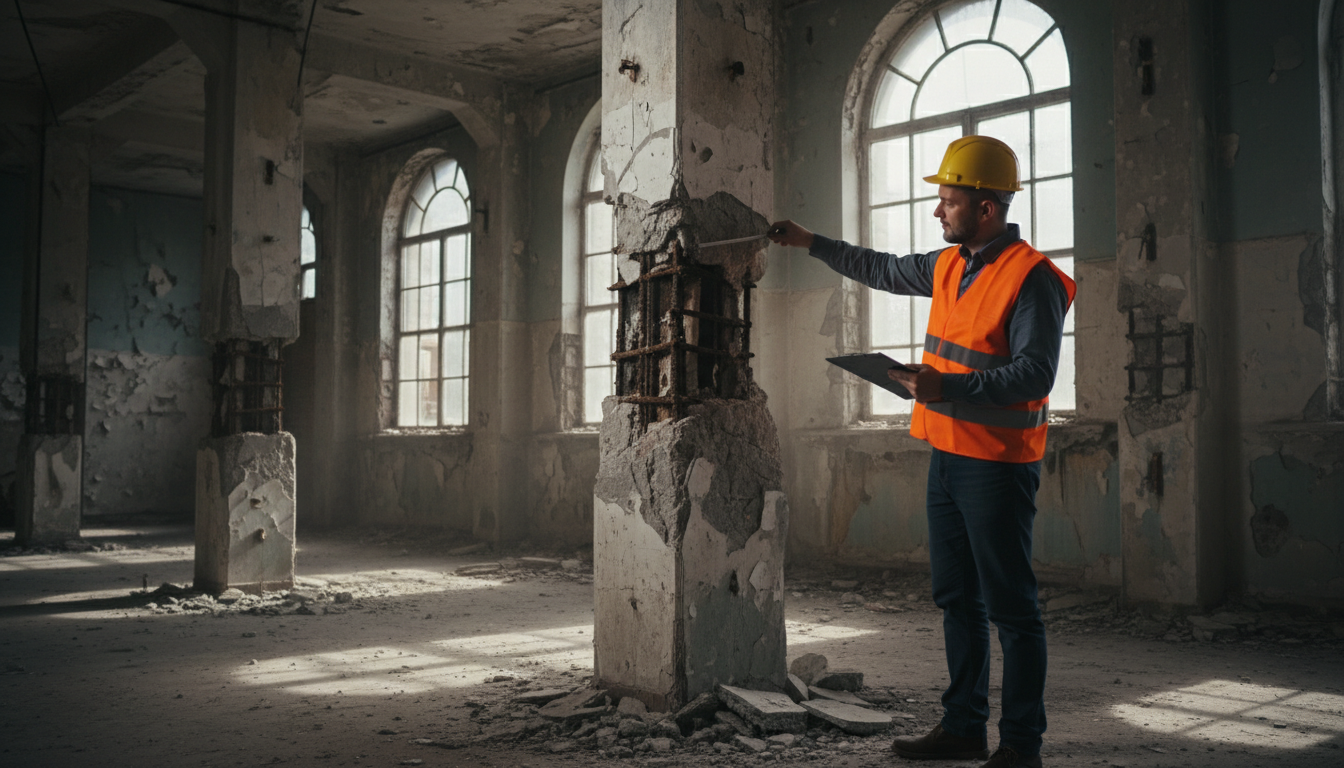
When a building fails — whether it’s a partial collapse, a catastrophic structural breach, or a slow-developing defect that only emerges years after construction — someone has to figure out why. That’s the job of a forensic structural engineer.
Forensic structural engineering is one of the most technical, most consequential, and most misunderstood specialties in the engineering profession. The work happens after the failure: there’s been damage, there may be injuries, there’s almost always litigation or insurance on the horizon, and the answers have to be both technically correct and defensible in court. This article walks through exactly what forensic engineers do, how they do it, and what to expect if you need to hire one.
Forensic structural engineering is the application of structural engineering principles to investigate the cause of damage, failure, or defective performance in buildings and other structures. The word “forensic” comes from the Latin forum — it refers to work that may ultimately be presented in a court of law.
Unlike design engineering, which creates new structures, forensic engineering looks backward: Why did this beam fail? Why did this wall crack? Why did this roof deflect? Was it a design error, a construction defect, a materials problem, an environmental event, or deferred maintenance? The forensic engineer’s job is to answer those questions with technical rigor and document the answers in a way that can withstand cross-examination.
Forensic structural engineers are typically hired by:
In our forensic practice across the Southeast, the causes of structural failure tend to fall into a few consistent categories:
1. Design errors. Calculation mistakes, missed load combinations, inadequate connections, unaccounted-for loads (especially point loads from mechanical equipment added after construction), or misapplication of the code.
2. Construction defects. Work not built per drawings, substituted materials, inadequate inspection, improper shoring during construction, missing connectors, wrong bolt sizes, or cold joints in concrete.
3. Material failures. Concrete with inadequate compressive strength, corroded steel, water-damaged wood, or rebar corrosion cracking the concrete that encases it.
4. Environmental events. Hurricanes, tornadoes, floods, fire, impact from vehicles or aircraft, seismic events, lightning, hail. The engineer has to separate “environmental overload” from pre-existing defects that made the building unable to survive a normal environmental event.
5. Aging and deferred maintenance. Structures degrade over time. Paint peels, coatings wear off, seals fail, water infiltrates, rebar corrodes, wood rots, steel loses cross-section. A building 30 years past its maintenance cycle will fail differently than one 30 years old but well-maintained.
Many failures have more than one cause. A correctly designed building with a minor construction defect may survive for decades until a significant weather event exposes the weakness. Part of the forensic engineer’s job is to apportion responsibility — often for the benefit of attorneys and insurers — among these overlapping causes.
A well-run forensic investigation follows a disciplined sequence. Skipping steps — or doing them out of order — creates gaps that opposing counsel will exploit later.
The first step is arriving at the site and documenting everything before anything is disturbed. The engineer takes:
At this stage, the engineer is not drawing conclusions — they’re preserving the evidentiary record. A site that’s been cleaned up, repaired, or altered before documentation loses most of its forensic value.
If the cause of failure is ambiguous, the engineer may need to collect physical evidence: fragments of failed members, concrete core samples, steel coupon samples for tensile testing, or rebar samples for yield strength testing. Chain-of-custody documentation is critical — each sample is labeled, logged, photographed in place before removal, and stored in a controlled environment.
On major losses, the engineer may also collect perishable evidence quickly — water levels in a flood case, char patterns in a fire case, or debris field layouts in a collapse — before cleanup crews disturb the scene.
Back in the office, the engineer reconstructs the loads on the failed member, compares them to the member’s calculated capacity (and to code-mandated capacity), and builds a structural model — often using Finite Element Analysis (FEA) software — to understand how forces moved through the structure at the moment of failure.
This analysis usually answers one or more of:
Before cutting or coring, the engineer may use non-destructive testing (NDT) methods to gather data without damaging evidence. Common NDT techniques include:
NDT is especially useful when the building is still occupied or when destructive testing isn’t feasible.
The deliverable is a formal written report. A good forensic report contains:
The report is written with the understanding that it may end up as a court exhibit. Every statement has to be defensible.
If the case goes to litigation, the forensic engineer may be retained as an expert witness. This involves:
Not every forensic engineer is an expert witness — expert witness work requires specific training, experience, and temperament. Many forensic investigations never become litigated; when they do, an engineer who can both investigate and testify effectively is extremely valuable.
A modern forensic structural engineering practice uses a mix of traditional tools and advanced technology:
Each case draws on different tools. A partial collapse in Charleston from hurricane damage uses different equipment than a foundation settlement investigation in Nashville.
Forensic structural engineering covers a wide range of situations. Typical matters include:
Every investigation is confidential — forensic engineers don’t publicly discuss active cases — but the patterns across cases teach us a lot about how buildings fail and how to build them better.
Don’t wait for litigation. The best time to call a forensic engineer is immediately after you suspect there’s a problem:
Early engagement preserves evidence, establishes a documented baseline, and often leads to early settlement before legal costs escalate.
What is the difference between forensic engineering and structural engineering?
Structural engineering is the broader discipline of designing and analyzing building structures. Forensic structural engineering is a specialty within it focused specifically on investigating damage, defects, and failures — and documenting findings in a form suitable for insurance, litigation, and repair planning. All forensic structural engineers are structural engineers; not all structural engineers do forensic work.
How long does a forensic structural investigation take?
A simple investigation — one damaged area, straightforward cause — can be completed in two to four weeks including the final report. Complex investigations involving multiple buildings, destructive testing, material analysis, or litigation-grade documentation typically take two to six months.
Who hires forensic structural engineers?
Insurance companies, attorneys (both plaintiff and defense), property owners, contractors, architects/engineers defending against defect claims, real estate investors, public agencies, and building owners trying to understand damage before making repair decisions.
What qualifications should a forensic engineer have?
At minimum: PE licensure in the relevant state(s), structural engineering experience, specific forensic training or documented casework, and — for litigation cases — expert witness experience. Multi-state licensure is a significant advantage for matters that cross jurisdictions.
Can forensic engineers serve as expert witnesses?
Yes, and many of the most experienced forensic engineers are regularly retained as expert witnesses. The investigation and the testimony are distinct services, though — and some engineers do one without the other. If there’s any chance your matter will involve testimony, hire a forensic engineer with documented expert witness experience from the start.
How much does a forensic investigation cost?
Forensic investigations are almost always scoped individually. Simple single-issue investigations are significantly less expensive than litigation-grade investigations involving multiple buildings, destructive testing, laboratory analysis, and expert reporting. Most forensic engagements are billed hourly with a budget estimate up front, because the engineer can’t predict in advance how many site visits, revisions, or depositions will be required. Always ask for a written scope, a budget estimate, and a check-in cadence so costs don’t surprise you.
Have a potential structural failure that needs investigation? Strut E&I’s forensic structural engineering team investigates building failures, construction defects, and storm damage across the Southeast — with PE licensure in 28+ states and documented expert witness experience. Request a confidential consultation.