

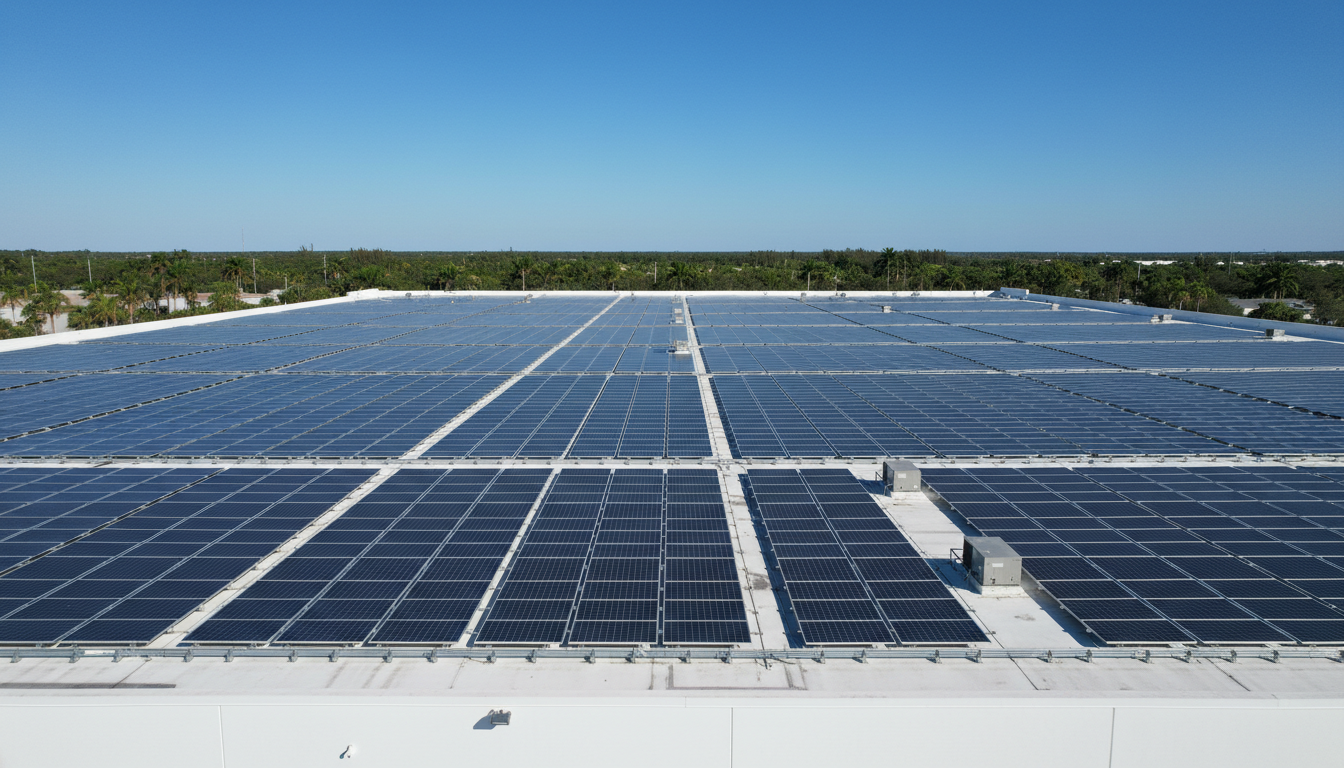
Before a single solar panel gets installed on a rooftop, a structural engineer has to answer a basic question: can the roof actually carry this? It’s a question that sounds simple but involves several layers of analysis — dead load, wind uplift, snow load, seismic considerations, and the current condition of the existing roof structure. Getting it wrong can mean anything from a failed permit inspection to a catastrophic structural failure during a hurricane.
This guide walks through exactly what structural engineers evaluate during a rooftop solar analysis, how different roof types behave differently, why wind uplift is the critical factor in the Southeast, and what solar installers should understand about the engineering behind their PE letters. If you read our guide to PE letters for solar installations, this is the companion piece that explains what’s happening behind the letter.
A complete rooftop solar structural analysis covers five load cases and the existing roof’s ability to resist them.
The solar array adds dead load to the roof. That load comes from:
The engineer calculates the total added dead load and confirms the existing roof framing can carry it with adequate safety margin under the governing code.
Wind uplift is the most critical load case for rooftop solar in the Southeast, and it’s where most of the engineering effort goes.
When wind flows over a roof, it creates negative pressure (suction) on the roof surface. This uplift force is trying to peel the roof and anything attached to it off the building. On solar arrays, uplift tries to lift panels up off the racking, lift racking off the attachment points, and transmit force directly into the roof deck and framing.
Uplift pressure is highest at roof edges, corners, and ridges — where flow separates and accelerates. A panel at the corner of a low-slope roof may see dramatically higher uplift than a panel in the middle of the same roof.
The engineer calculates wind uplift using ASCE 7 (the current edition at the time of analysis, typically ASCE 7-22 in 2026) and verifies that:
In high-wind zones, all of these checks become more demanding. A solar array in Miami or Key West has to resist wind forces that are fundamentally different from the same array in Atlanta.
Less critical in most Southeast markets, but real in parts of Nashville and higher elevations of North Carolina. The concern isn’t just the snow that falls on the panels — it’s snow drifting. A solar array can act as an obstruction on the roof, causing snow to pile up on the windward side. The engineer calculates the expected snow accumulation and confirms the roof can carry it.
Ground snow loads in the Southeast are generally modest — most of Georgia, Florida, South Carolina, and coastal Carolinas have very low ground snow loads. Tennessee and the higher elevations of North Carolina have meaningful ground snow loads that affect design.
Seismic loads are rarely controlling in the Southeast, but the engineer still checks them. Solar arrays contribute mass to the roof, which increases the seismic force the building has to resist. Ballasted systems also have to be analyzed for sliding under seismic motion, since they rely on friction rather than attachment.
Most Southeast markets have low seismic design categories where seismic isn’t the controlling load case. But the analysis still happens.
The engineer evaluates combinations of the individual loads per ASCE 7 load combination equations. The governing combination for solar in the Southeast is typically:
The engineer checks every member against the governing combination. A design that passes dead load but fails under dead plus wind has not actually been analyzed properly.
Not all roofs are the same. The structural engineer has to understand the existing roof system before the analysis can proceed. Different roof types behave very differently under solar loads.
Standing seam metal roofs are generally a good solar substrate. Mounts clamp onto the seams without penetrating the roof surface, transferring loads directly into the seams and the underlying structure. Analysis focuses on the clamp-to-seam capacity and the underlying framing capacity.
Corrugated and R-panel metal roofs are more complex. Mounts typically screw through the panel into purlins below, which means the engineer has to verify purlin capacity and spacing. Penetrations introduce water infiltration risk that has to be managed.
Low-slope commercial roofs (TPO, EPDM, modified bitumen, built-up asphalt) are very common substrates for commercial solar. The engineer has to evaluate the roof deck (typically metal, wood, or concrete), the decking’s fastener capacity, and the underlying framing.
Ballasted systems are common on membrane roofs because penetrating the membrane creates maintenance headaches. Ballasted systems simplify installation but increase structural loads significantly — because the entire ballast weight is distributed across the array area.
Concrete plank and steel decking systems are often the strongest roof substrate for solar. Concrete decks can support heavy ballasted systems without issue. Steel decking can vary — the engineer has to verify the deck gauge, span, and fastener capacity.
Wood rafters, trusses, and engineered I-joists are common in residential and some commercial buildings. The engineer has to check every rafter or truss in the array area, the sheathing at the attachment points, and the overall roof system capacity. Older wood-framed buildings with smaller or weaker framing may need reinforcement before solar can be added.
Common in mid- to high-rise commercial. Generally strong and well-documented. Analysis focuses on attachment point detailing and making sure concentrated loads from ballast or attachment don’t exceed deck capacity.
One of the most important early decisions in a commercial solar project is whether to use a ballasted or attached (penetrating) system. Each has structural implications.
Attached systems penetrate the roof surface with mechanical fasteners that tie directly into the underlying structure. Pros: lower total weight, better uplift resistance, more flexibility in array layout. Cons: more penetrations (water infiltration risk), requires verification of underlying framing at every attachment point.
Ballasted systems use weight (concrete blocks, pavers, precast ballast) to hold the array in place without penetrating the roof. Pros: no penetrations, simpler and faster installation, typically preferred for leased rooftops and membrane roofs. Cons: significantly higher dead load, limited uplift resistance (in high-wind zones, ballasted systems are often not viable), limited to low-slope roofs.
In high-wind zones — Miami, Tampa, Key West, and coastal Carolinas — ballasted systems often don’t work. The wind uplift exceeds what ballast weight can resist, so the array has to be attached. Structural engineers working on solar in Tampa and other Florida markets see this constraint regularly.
In our practice providing PE letters and structural analyses for solar across the Southeast, the most common issues that delay projects:
Most of these issues can be avoided with early engineering engagement. Waiting until the permit submittal to involve a structural engineer is how projects stall.
Georgia. Enforced at state and local level with Georgia amendments to the IBC. Most jurisdictions require PE letters or full engineering for commercial solar and for residential exceeding prescriptive limits.
Florida. Florida Building Code (FBC), among the strictest in the country. Wind speeds reach over 180 mph in the HVHZ (Miami-Dade and Broward). Full structural engineering is typically required for commercial solar, and residential in the HVHZ often requires engineering too.
South Carolina. Commercial solar requires engineering in most jurisdictions. Coastal counties have higher wind loads and tighter requirements.
North Carolina. Commercial solar requires engineering. Coastal counties and Outer Banks have significant wind loads.
Tennessee. Less strict than coastal states but commercial solar still typically requires engineering. Snow load becomes a factor at higher elevations.
Can any roof support solar panels?
No. Some roofs can’t. Older buildings with deteriorated framing, buildings with inadequate design loads, and buildings with damaged roof decks may need reinforcement before solar can be added — or may not be suitable for solar at all. The structural analysis tells you which category your roof falls into.
How much weight do solar panels add to a roof?
Panel-and-racking dead load for attached systems typically runs 3–5 pounds per square foot (psf) distributed over the array area. Ballasted systems add substantially more — often 5–8 psf or higher, depending on the ballast design. That’s concentrated in the area of the array, not spread over the whole roof.
What if my roof needs reinforcement for solar?
Reinforcement is possible in most cases. The engineer designs reinforcement (sistering joists, adding new framing members, strengthening connections) that makes the existing roof capable of carrying the new loads. The cost of reinforcement has to be weighed against the project economics, but it’s rarely a showstopper.
Do I need a structural engineer for ground-mounted solar?
Yes — almost always. Ground-mounted systems require foundation design for the posts and wind load analysis for the racking. Ground-mounted solar typically requires more engineering than roof-mounted, not less.
How long does a solar structural analysis take?
Simple residential projects can be completed in 3–7 business days if the existing framing is well-documented. Commercial projects typically take 2–4 weeks. Complex projects involving ballasted systems, older roofs, or reinforcement design can take 4–8 weeks.
What’s the difference between a PE letter and a full structural analysis?
A PE letter is a summary document — the engineer has done the analysis and is certifying the conclusion in letter form. A full structural analysis is the actual calculation package. For simple residential projects, a letter may be all that’s required. For commercial projects, reviewers often want to see the full calculations. The engineer can provide either or both as needed.
Planning a commercial solar installation in the Southeast? Strut Engineering & Investment, Inc. provides full structural analysis, PE letters, and reinforcement design for solar projects across 28+ states. Contact our solar PV structural engineering team.