

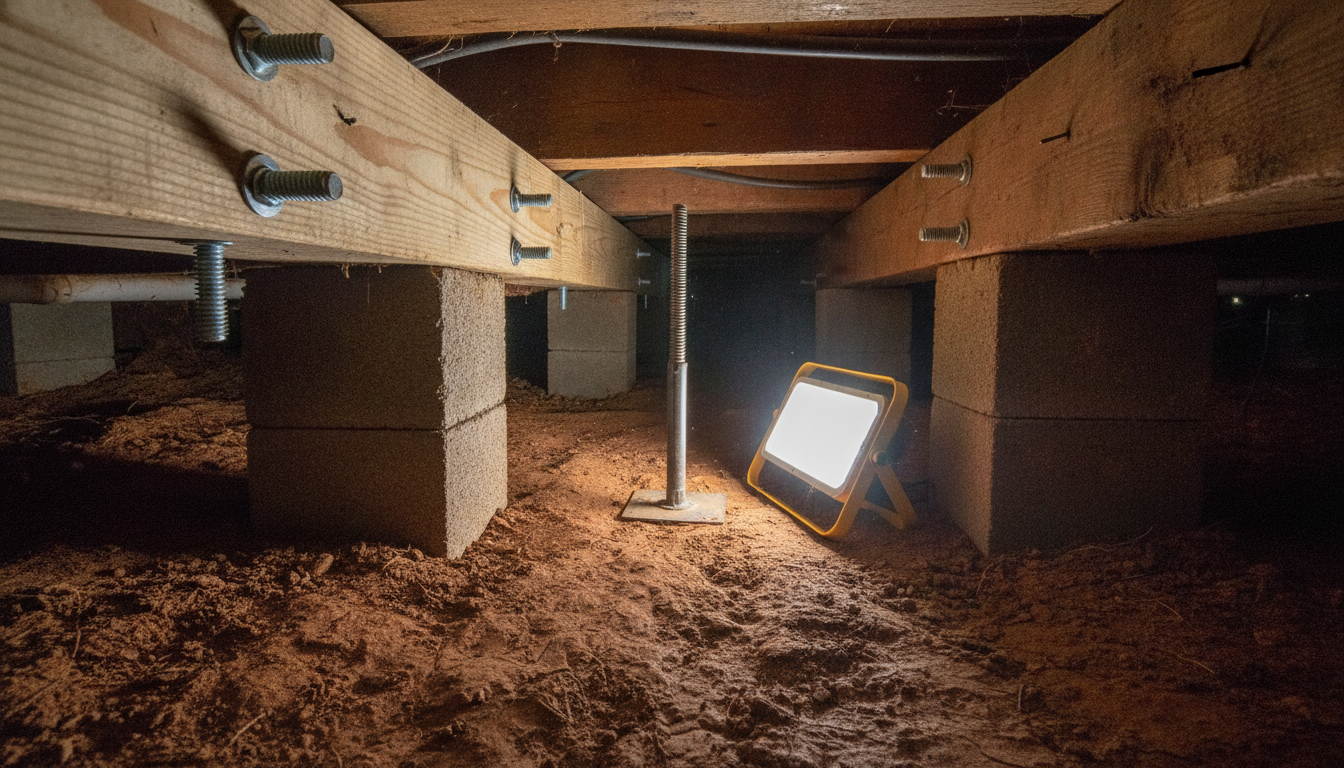
Sistering floor joists is one of the most common structural repairs in older homes, and it’s often a good one. A new piece of lumber is fastened alongside a weak or damaged joist so the two act together and carry the floor. Done right, it stiffens a bouncy floor and restores strength to a damaged member for a fraction of the disruption of replacing it.
Done wrong, it adds wood without fixing anything. A sister that doesn’t bear on anything at its ends, or one bolted to a joist that is sagging because its support has dropped, looks like a repair and behaves like decoration. If you’re not sure which situation you have, a residential structural inspection by a licensed engineer will tell you why the floor is sagging before anyone starts cutting lumber.
This guide covers sistering from an engineer’s point of view: what it actually does, when it works, when it fails, and when the job needs a design and a permit.
A floor joist is a beam. It spans between supports and carries the floor load by bending. When a joist is too weak for its span, or has lost strength to damage, it deflects more than it should. You feel that as bounce, see it as a dip, and sometimes hear it as cracking drywall in the ceiling below.
A sister joist is a second member fastened to the side of the original. If the two are connected well enough to behave as one, the combined section is much stiffer and stronger than the original alone. That’s the entire principle. Everything that makes sistering succeed or fail comes back to two questions:
If both answers are yes, sistering is a legitimate structural repair. If either is no, it isn’t.
Sistering is a good fit when the problem is the joist itself and the supports are sound. Typical cases:
Older homes, and some newer ones, have joists that meet the minimum for strength but are too flexible for comfort. The floor isn’t failing; it just bounces when someone walks across the room. Sistering full-length members onto every joist in the affected area is a standard way to stiffen it.
A section of joist that was notched for a pipe, drilled too close to the edge, or cracked at a knot can often be reinforced with a sister that extends well past the damaged zone on both sides. The sister bridges the weak spot.
A heavy tub, a stone countertop island, a piano, or a new partition wall above can put more load on a few joists than they were designed for. Sistering the affected joists is often part of the answer, though the load path below still has to be checked.
This is where most failed repairs come from. A sagging floor has several possible causes, and sistering only addresses one of them.
A joist delivers its load to its supports: a beam, a wall, a sill plate on the foundation. A sister that stops short of those supports, or “floats” between them, only works if the connection to the original joist can transfer the load to it. In many repairs it can’t do that well. The strongest repairs run the sister full length and give it its own bearing at both ends. A short sister in the middle of a span can help with local damage, but it should not be treated as a cure for a joist that is too weak overall.
If the girder beam, the pier, or the foundation wall the joists sit on has settled, every joist resting on it sags with it. Sistering those joists does nothing, because the joists aren’t the problem. The fix is at the support: shimming or replacing a pier, adding a post and footing, or addressing settlement. Our guide to crawl space foundation repair covers those conditions, and our foundation repair engineering service exists for exactly this situation.
A practical tell: if the sag is concentrated along a line that runs perpendicular to the joists, look at the beam or wall under that line before you look at the joists.
Sistering a joist that is being eaten by termites or soaked by a plumbing leak buys time at best. The damage keeps spreading, often into the sill plate and the band joist where you can’t sister at all. The moisture source or infestation has to be stopped first, and the extent of damage has to be measured, not guessed. Soft wood that can be probed with a screwdriver is often far more extensive than it looks. We wrote about how moisture undermines framing in our guide to water damage and structural integrity.
When a post, a bearing wall, or a beam above lands on a joist, that joist is carrying a concentrated load it may not have been designed for. Sistering it can help, but the load still has to get down to the foundation. That often means a new post and footing below, which is a design question rather than a carpentry question. The same logic applies when a wall above is removed and replaced with a beam; see what replaces a load-bearing wall.
Some floors sag because the joists span too far for their size. Sistering helps, but a second line of support, a new beam and posts midspan, can be the better and simpler answer. An engineer can compare the options.
We don’t recommend sistering structural members based on a blog post, and the right fastener schedule depends on the load, lumber, and span. But the general principles explain why some repairs work and others don’t:
If those details sound like they depend on the specific floor, they do. That’s the point at which an engineer earns the fee.
Call a structural engineer before sistering if you see any of these:
Our guide to warning signs of structural damage goes deeper on these.
For a few sisters on a bouncy floor with sound supports, many jurisdictions treat the work as a repair. But building departments vary, and once the work involves damaged structural members, new posts or footings, a changed load path, or any load-bearing modification, most require a permit and many will ask for sealed engineering.
There’s also a practical reason to involve an engineer even when a permit isn’t required. The most expensive sistering job is the one done on the wrong problem. An engineer’s inspection identifies the actual cause of the sag, specifies the repair, and documents it. That documentation is useful later at resale, when a buyer’s inspector notices sistered joists and wants to know whether the repair was designed.
Strut Engineering & Investment, Inc. evaluates sagging and damaged floors throughout Greater Atlanta and the Southeast. Our structural rehabilitation and building modification work covers repair design for existing framing, and every project is handled by a dedicated licensed structural engineer.
Yes, when the joist itself is the problem and the supports are sound. A properly sized, well-fastened sister that bears at its ends makes the combined member much stronger and stiffer. It does not fix a floor that sags because a beam, pier, or foundation below has settled.
As long as practical. Full-length sisters that bear on the same supports as the original joist perform best. For localized damage, the sister should extend well past the damaged area on both sides. The exact length and fastening should come from an engineer when the joist is damaged or carrying extra load.
Usually, yes. Fastening a sister to a joist that is still sagging locks the sag in place. Jacking should be slow and controlled, often over days or weeks, to avoid cracking finishes and shifting loads unexpectedly. Temporary support must be safe and properly placed.
Only after the source is stopped and the extent of damage is known. Active rot or infestation continues to spread, often into the sill plate and band joist. Severely damaged members may need replacement rather than sistering.
It depends on your jurisdiction and the scope. Simple reinforcement may be treated as repair work, but damaged members, new posts or footings, and changes to the load path commonly require a permit and sometimes sealed drawings. Check with your local building department before starting.
When the sag is getting worse, runs along a line across the joists, appears with foundation cracks or sticking doors, involves damaged wood, or follows a renovation that changed loads. An engineer identifies the cause first, so you repair the right thing.
Before anyone adds lumber, find out what is actually wrong. Strut E&I will inspect the framing and supports, tell you whether sistering is the right repair, and design it if needed. Call (404) 480-5555, email info@struteni.com, or contact our team to schedule an inspection.