

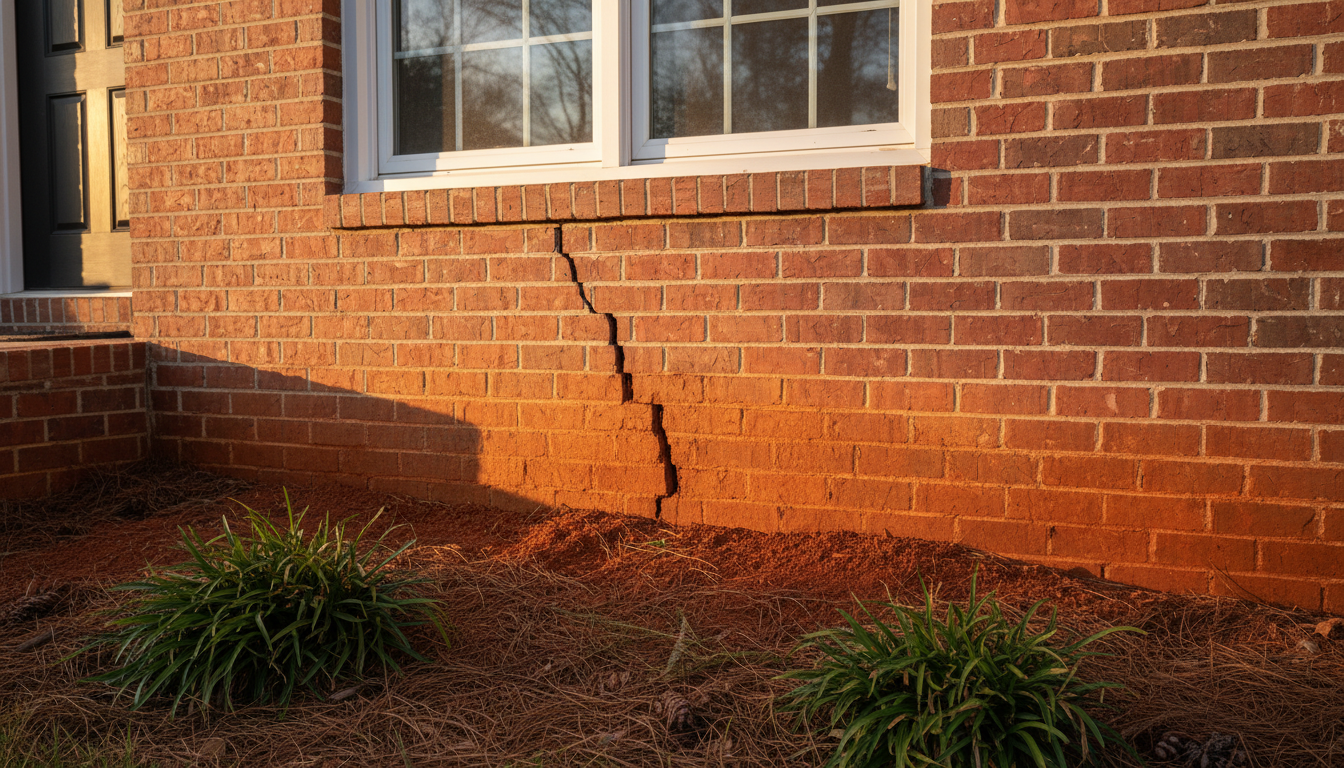
Foundation settlement is the most common structural issue we investigate across the Southeast. Nearly every house and commercial building will experience some settlement during its first few years — that’s normal. The problem is when settlement keeps going, happens unevenly, or exceeds what the structure above can tolerate. At that point, cracks appear, doors stop closing, floors slope, and owners start to worry.
This guide explains what foundation settlement actually is, how to tell normal settlement from problematic settlement, the specific soil conditions that cause foundation problems across the Southeast, and when it’s time to bring in a structural engineer.
When a building is constructed, its weight transfers through the foundation into the soil below. Soil compresses under load — it’s not perfectly rigid. As the soil compresses, the foundation moves downward. That movement is called settlement.
Some settlement is unavoidable. A building resting on 30 feet of clay will compress that clay measurably over time. What matters for structural performance is how much, how fast, and — most importantly — whether the settlement is uniform or differential.
Uniform settlement means the entire foundation moves down evenly. If a 200-foot-long building settles an inch uniformly, nothing inside the building notices. Doors still close, floors are still level, walls don’t crack.
Differential settlement means one part of the foundation moves more than another. Even a half-inch of differential across a 40-foot wall can crack the wall, distort the frame, and create a cascade of symptoms. Differential settlement is the reason foundation problems become visible — and it’s almost always what causes structural damage.
The rule of thumb most structural engineers use:
The key question isn’t just how much the building has moved — it’s whether the movement is still happening. A house that settled 1.5 inches in its first five years and has been stable for the 30 years since is probably fine. A house that has been settling a quarter-inch per year for the last decade has an active problem that will only get worse.
The Southeast has several soil conditions that cause more than their share of foundation problems. Here are the ones we investigate most often:
Much of Georgia, North Carolina, South Carolina, and Tennessee sits on expansive clay — soil that swells when wet and shrinks when dry. A clay foundation soil that’s wet in March and dry in September can move a quarter-inch or more seasonally. Over years, this cyclic movement causes cracks, distorted framing, and wall damage.
Clay is especially problematic in areas like the Piedmont region of Georgia and the Carolinas, parts of Tennessee (Nashville sits on clay and limestone), and the heavy clay belts of North Georgia.
Water is the single most important factor in foundation performance. When gutters overflow, downspouts dump water next to the foundation, or site grading slopes toward the building instead of away, the soil under the foundation becomes saturated. Saturated clay expands. Saturated sand loses density. Both cause settlement.
Many foundation problems we investigate are really drainage problems. Fixing the drainage often stabilizes the foundation without any structural intervention at all.
Trees — especially oaks, maples, and poplars — draw huge amounts of water out of the soil during the growing season. A mature tree within 20–30 feet of a foundation can desiccate the soil beneath one side of the building, causing that side to settle. We see this a lot in older neighborhoods with established canopy trees.
Older buildings — and some newer ones built by contractors who skipped geotechnical work — often have foundations that were never sized properly for the soil conditions. Shallow footings on clay, unreinforced slabs, footings built on uncompacted fill, footings built over buried organic material. These buildings settle not because of new conditions but because the foundation was never adequate to begin with.
Any significant change to the moisture content under a building causes movement. Broken water pipes, sewer leaks, irrigation over-watering, HVAC condensate discharge, and extended droughts all cause soil movement. A burst water line beneath a slab can cause dramatic settlement in weeks.
New construction next door that involves excavation, dewatering, or vibration can cause nearby structures to settle. Cities with significant new development — Nashville, Charlotte, Raleigh, Atlanta’s Buckhead and Midtown — see this regularly.
Foundation settlement rarely announces itself as “foundation settlement.” It shows up as symptoms elsewhere in the building. Watch for:
Most of these same signs can indicate other problems — so they’re triggers for investigation, not definitive diagnoses. See our full guide to warning signs of structural damage for more.
When we’re called in to evaluate foundation settlement, the process usually looks like this:
Structural engineers don’t perform foundation repairs — that’s the contractor’s job — but we design them and oversee the work. Common repair techniques include:
The right repair depends on the cause, the extent, the building type, and site constraints. A cheap repair that addresses the symptom without addressing the cause usually fails within a few years.
Every city has its own soil story. A few common patterns:
If your building hasn’t settled yet, keep it that way:
How much foundation settlement is acceptable?
Most engineers consider total settlement under 1 inch acceptable if it’s uniform and historical (not ongoing). Differential settlement — where one part of the foundation moves more than another — is the real concern, and even small amounts of differential settlement (say, 1/4 inch over 20 feet) can cause visible damage.
Can foundation settlement be fixed?
Yes, almost always. The right fix depends on the cause and extent. Drainage corrections, helical piers, push piers, slab jacking, and underpinning are all standard techniques. A structural engineer can design the appropriate repair and oversee the installation.
Does foundation settlement always require an engineer?
No. Minor cosmetic cracking in older buildings with stable foundations is often just historical movement that has long since stopped. But any active movement, any significant cracking, any differential settlement, or any change in floor level warrants engineering evaluation. The cost of a proper evaluation is almost always less than the cost of guessing wrong.
How much does foundation settlement repair cost?
It depends entirely on the cause and extent. Minor interventions like drainage correction or crack injection are relatively affordable. Helical pier or push pier installation is a significantly larger investment, and complex underpinning of a large commercial building can be substantial. A structural engineer can scope the actual work required and help you evaluate contractor bids on equal footing.
Is foundation settlement covered by insurance?
Generally no. Most standard homeowner and commercial property policies exclude “earth movement” and gradual settlement. Coverage is typically available only when the settlement is caused by a specific covered event — a burst water line, for example. A forensic structural engineer can help document the cause of loss if you’re pursuing a claim.
What is differential settlement?
Differential settlement is uneven movement — one part of the foundation settling more than another. It’s the main cause of visible damage from foundation problems. Uniform settlement (the whole foundation dropping together) usually doesn’t cause damage; differential settlement does.
Concerned about foundation movement? Strut E&I’s structural engineers evaluate foundation settlement, design repairs, and work with contractors across Georgia, Florida, South Carolina, North Carolina, and Tennessee. Contact us for a foundation evaluation — catching it early is always cheaper than waiting.
Related reading: Existing settlement is one of the first things an engineer checks when a homeowner asks about building upward, because a second story concentrates new load onto the same footings. See Can My Existing Foundation Support a Second-Story Addition? and our second-story addition structural engineering services.