

Structural problems rarely appear overnight. Almost every major structural failure we’ve investigated as forensic engineers showed warning signs for months — sometimes years — before anything dramatic happened. The building was trying to tell someone something was wrong. Nobody recognized the signals.
This guide walks through the seven warning signs of structural damage we see most often in commercial buildings across the Southeast. If you notice any of them, the right next step is to call a licensed structural engineer before the problem gets worse. Early detection consistently turns five-figure repairs into four-figure ones — and sometimes prevents the kind of failure that lands on the news.
Not every crack is a structural problem, but some are unmistakable warnings.
Hairline cracks in concrete or stucco are often cosmetic — shrinkage during curing or thermal movement. They’re annoying, not dangerous.
Diagonal cracks running at roughly 45° — especially near the corners of doors or windows — are usually a sign of differential foundation movement. Something beneath one portion of the building is settling faster than the rest, and the wall is tearing itself apart to accommodate the movement.
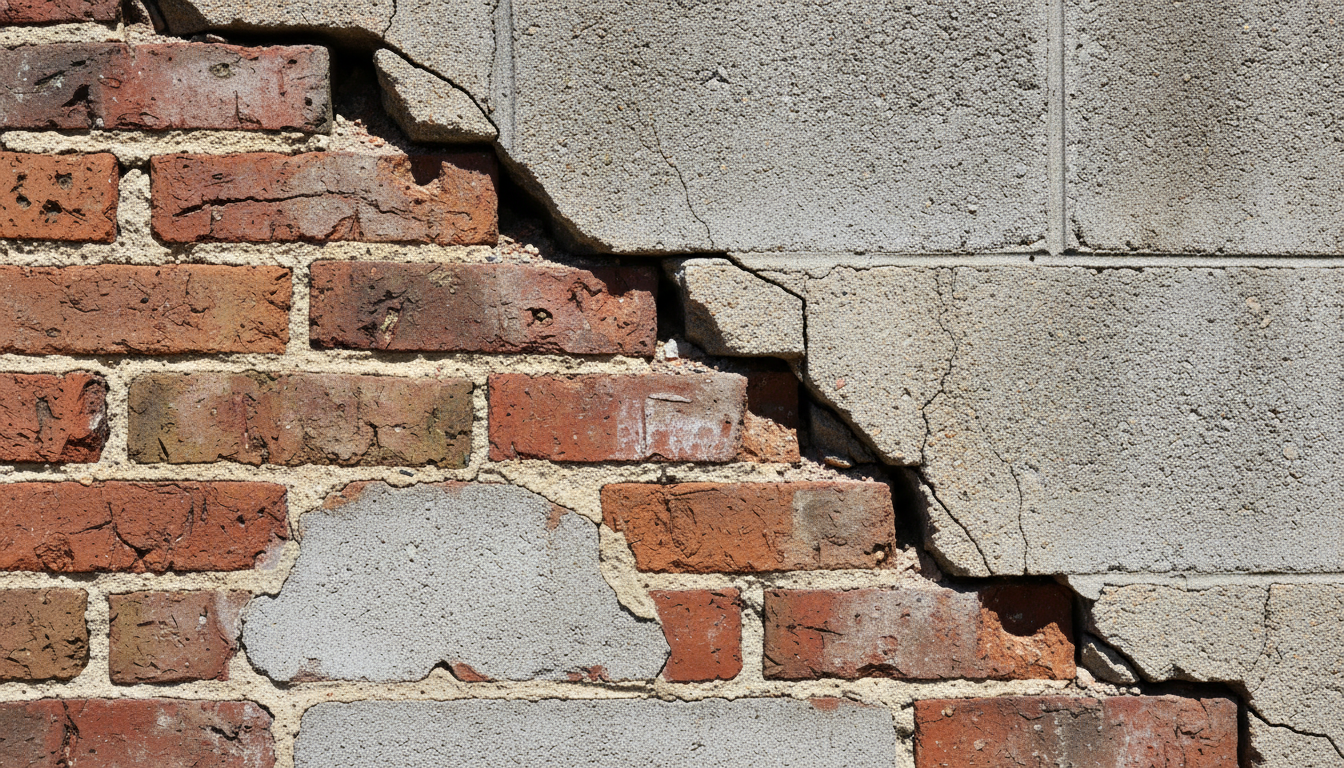
Stair-step cracks in masonry or block walls are a classic sign of foundation settlement. Each step represents a weak mortar joint yielding to tension.
Horizontal cracks in basement or foundation walls are the most serious. Horizontal cracking typically indicates lateral pressure from soil or water pushing the wall inward. Horizontal cracks should always be evaluated immediately.
Widening cracks — of any type — are a red flag. A crack that’s wider at one end than the other, or a crack that grows over time, is active and deserves engineering attention.
A level floor is a simple diagnostic. Place a marble or a ball on the floor in the middle of a room. If it rolls noticeably in any direction, something underneath has moved.
Common causes include:
– Foundation settlement (the ground is giving way)
– Rotted or compromised floor joists (moisture, termites, overloading)
– Missing or inadequate mid-span supports
– Excessive live load from added equipment or storage
In commercial buildings, sagging floors often appear first in corridors between tenant spaces or under heavy point loads like equipment or filing cabinets. We’ve investigated multiple cases where “the floor feels soft” turned out to be the early stage of a joist failure.
When doors and windows suddenly start sticking, binding, or refusing to latch, the building has moved. Door and window frames are designed to sit square. When the surrounding structure racks (shifts out of square), the frames rack with it and the hardware stops working.
A single sticking door in a humid month is usually just swelling. But if multiple doors on the same side of the building all start sticking at the same time — especially paired with cracks in the walls above them — that’s a structural signal, not a weather signal.
Walls should be vertical. If you see a wall that’s bowing inward or outward, or leaning away from plumb, something is seriously wrong.
Causes include:
– Foundation failure pulling the wall off its footing
– Lateral soil pressure pushing on below-grade walls
– Water damage rotting the sill plate or bottom of the wall
– Roof spread — the roof is pushing the tops of the walls outward because of inadequate lateral bracing
A simple way to check is to hold a long level vertically against the wall. If the bubble is significantly off-center, there’s measurable lean. Any measurable lean on a load-bearing wall should be evaluated by a structural engineer.
Water is the single most destructive force on buildings. It doesn’t usually cause sudden collapse, but it erodes structural capacity over years and decades — rotting wood, corroding steel, degrading concrete, weakening masonry.
Warning signs of water-related structural damage include:
– Efflorescence (white powdery deposits) on masonry indicates water migration
– Rust stains on concrete suggest embedded rebar is corroding — a serious problem because corroded rebar expands and cracks the surrounding concrete
– Soft or spongy wood framing near plumbing, roof leaks, or crawl spaces
– Peeling paint or staining patterns that reveal a long-standing leak
Coastal buildings — Miami, Charleston, Savannah, Tampa, Key West — are especially vulnerable because salt-laden air accelerates corrosion. Our forensic structural engineering team investigates salt-induced concrete deterioration across the Southeast coast.
Exposed structural steel in industrial buildings, parking garages, and older commercial structures is vulnerable to corrosion. Light surface rust is normal. Scaling rust — the kind where you can flake material off with a screwdriver — is not.
Look for:
– Thickness loss on steel columns, beams, and connections
– Rust bleeding from connection bolts
– Concrete spalling around embedded steel (rebar, anchor bolts)
– Pitting on exposed steel surfaces
Once a steel member loses significant cross-section, its load capacity drops quickly. A forensic assessment can measure the remaining thickness with ultrasonic testing and calculate whether the member is still adequate.
Gaps opening up where walls meet ceilings, where walls meet floors, or where two walls meet at a corner are a sign that parts of the building are moving relative to each other. Common causes:
A small gap on one interior wall during a dry season may be seasonal movement. Gaps opening across multiple walls, or growing from year to year, need investigation.
A forensic structural engineer specializes in investigating the cause and extent of damage — not just fixing it. You want a forensic engineer when:
The forensic investigation produces a documented report suitable for insurers, attorneys, and permitting authorities. It’s a very different deliverable from a contractor’s repair estimate.
Are hairline cracks in concrete dangerous?
Most hairline cracks — smaller than 1/16 inch — are shrinkage or thermal cracks and are not structural. The concern is when hairline cracks are growing over time, are part of a larger pattern, or appear in unusual locations like the middle of a slab or in a load-bearing wall.
How do you know if a crack is structural or cosmetic?
Key indicators that a crack is structural: diagonal or horizontal orientation, width greater than 1/8 inch, offset faces (one side is higher than the other), growing over time, or appearing in load-bearing members. When in doubt, have a structural engineer look at it.
Can structural damage be repaired?
Almost always, yes. Foundation problems can be underpinned with helical or push piers. Walls can be reinforced with carbon fiber or steel plates. Damaged beams can be sistered or replaced. The question is usually not “can it be fixed” but “how much will it cost.”
How much does it cost to fix structural damage?
It depends entirely on the cause, extent, and location of the damage. Minor, localized repairs like crack injection or targeted reinforcement can be relatively affordable. Full foundation repair involving underpinning or helical piers is a much larger investment, and complex rehabilitations of damaged commercial structures can run significantly higher. A structural engineer’s evaluation will scope the actual work required and allow you to compare contractor bids apples-to-apples.
Does insurance cover structural damage?
It depends on the cause. Insurance typically covers sudden damage from covered perils (fire, storm, vehicle impact). It generally doesn’t cover gradual damage from settlement, water infiltration, maintenance neglect, or construction defects. Claims involving structural damage almost always require an engineering report to document the cause of loss.
How long does a structural damage assessment take?
A simple assessment can be completed in a day or two, including site visit and short report. A full forensic investigation involving testing, analysis, and formal reporting typically takes two to six weeks.
Seeing warning signs in your building? Strut E&I provides forensic structural investigations across Atlanta, Savannah, Miami, Charleston, Charlotte, and the rest of the Southeast. Request a forensic evaluation before a small problem becomes a big one.
Related: Cracked drywall, sagging floors, and doors that stop closing are classic symptoms of a load path that was interrupted — often by a wall that was removed without proper support. See load-bearing wall removal engineering.