

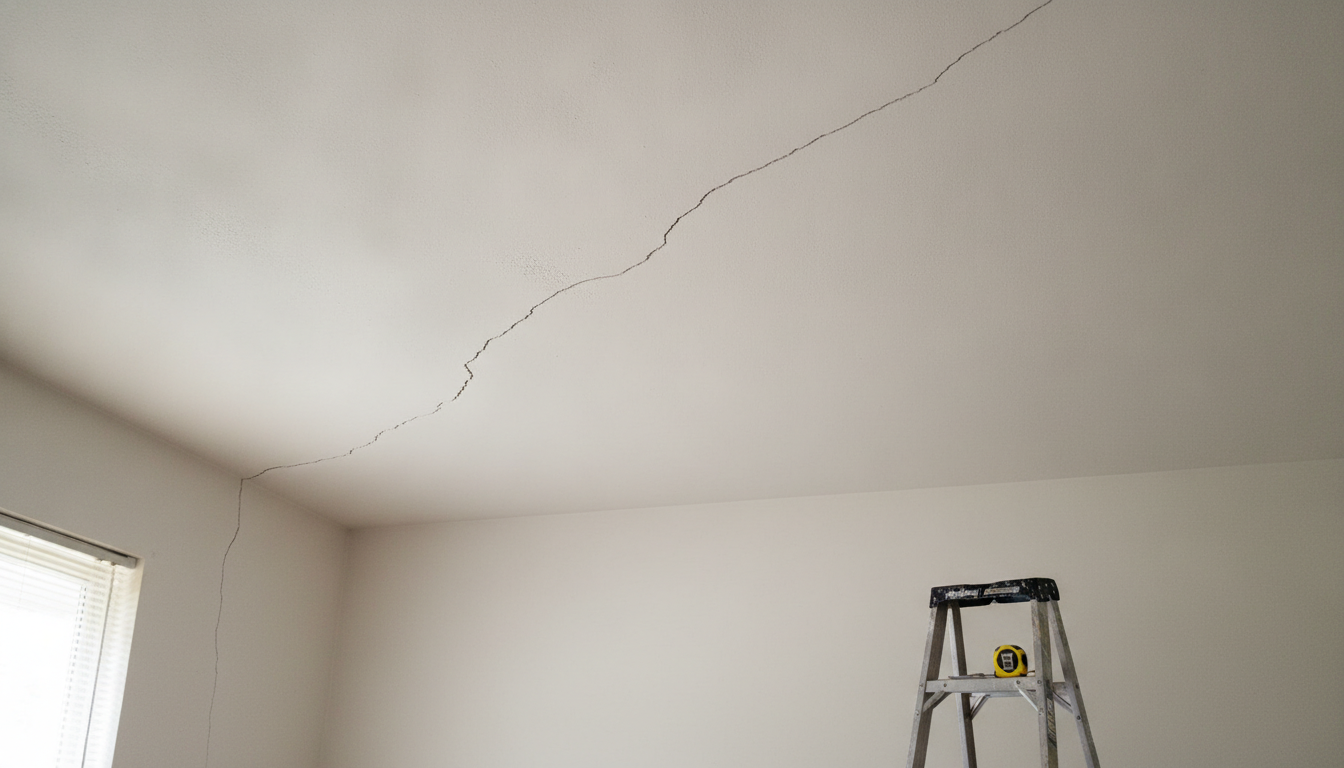
You look up one evening and there it is: a crack in the ceiling that you are fairly sure was not there last spring. Maybe it is a hairline running along a seam. Maybe it is longer, wider, and has a slight dip next to it. Either way, the question is the same. Is this paint and drywall, or is it the house telling you something?
Most ceiling cracks are cosmetic. Some are not, and the ones that are not tend to share a handful of recognizable traits. This guide walks through those traits, explains what causes each type of ceiling crack, and covers when it makes sense to have a licensed engineer look at it. If you already have more than one warning sign, skip ahead and book a residential structural inspection so you get a definite answer rather than a guess.
A drywall ceiling is a thin, brittle skin fastened to the framing above it. That framing is either floor joists (if there is a floor above) or ceiling joists and roof trusses (if the attic is above). Wood framing moves. It shrinks as it dries, swells with humidity, deflects under load, and shifts when the foundation below it moves. Drywall does not stretch, so when the framing moves enough, the drywall cracks at its weakest point, which is usually a taped seam or a corner.
That means a ceiling crack is a symptom, not a diagnosis. The useful question is not “is there a crack?” but “what moved, how much, and is it still moving?”
These are common in houses of every age and rarely indicate a structural problem on their own.
A thin, straight crack that follows the line where two sheets of drywall meet is usually a tape joint that has let go. Seasonal humidity swings, normal framing shrinkage in the first year or two of a house’s life, and a skimpy layer of joint compound all cause this. It looks like a perfectly straight line, often running the full length of a sheet.
A cluster of very fine cracks radiating in a small area is often a texture or paint issue, especially in older homes with plaster or heavy texture coats. They tend to stay small and do not change much year to year.
A short crack radiating from a fixture box is often caused by vibration from a fan or by the fixture having been installed or reinstalled roughly. Check that the fan is mounted to a fan-rated box and is not wobbling.
Small round bumps or short cracks in a regular grid pattern are fasteners backing out as framing dries. They are a finishing issue.
Cosmetic does not mean “ignore forever.” Note the date, take a photo with something for scale, and look again in a few months. A crack that stays the same is a good sign. A crack that grows is not.
These are the patterns that most often trace back to a structural cause. One of them by itself is a reason to pay attention. Two or more together is a reason to call.
If the ceiling dips on one side of the crack, or you can see a gentle bow when you look across the ceiling at a low angle with a flashlight, the framing above may be deflecting more than it should. Causes include undersized or damaged joists, a removed or modified wall below, a heavy load added above (a tub, a bookshelf wall, storage in the attic), or rot and insect damage. Sagging joists are often repaired by reinforcing them, a technique we cover in our guide to sistering floor joists, but the cause has to be identified first.
When a ceiling crack turns the corner and continues down the wall, the movement is not confined to one drywall seam. That pattern often points to differential movement in the structure, such as foundation settlement under one part of the house. It is one of the warning signs of structural damage we see most often during inspections.
A small separation at the top of an interior wall can be truss uplift, a seasonal phenomenon in roof trusses that is usually not a safety concern. But a gap that keeps widening, appears at an exterior wall, or comes with sticking doors and windows deserves a closer look, because it can also indicate settlement or a wall that has lost bearing.
Width matters. A crack you can slide a coin into, or one where one side sits noticeably lower than the other (an offset), indicates more movement than normal shrinkage produces.
New cracks within weeks or months of a wall being removed, an opening widened, or a second floor added are a red flag. They can mean the load path was not fully restored. If that work involved a bearing wall, our page on load-bearing wall removal explains what a correct beam, post, and footing design looks like.
Brown or yellow staining along a crack points to a leak from a roof, a plumbing line, or an HVAC drain. The water problem comes first, but long-term wetting can soften drywall and rot the framing above it. Our guide to water damage and structural integrity covers what happens to wood framing when leaks go unnoticed.
| What you see | Most likely cause | What to do |
|---|---|---|
| Straight hairline along a seam | Tape joint failure, seasonal movement | Monitor; repair cosmetically |
| Fine spiderweb pattern | Texture or paint shrinkage | Cosmetic repair |
| Crack plus visible sag | Overloaded, damaged, or undersized framing | Engineer evaluation |
| Crack continuing down a wall | Differential movement, possible settlement | Engineer evaluation |
| Crack that reopens after patching | Ongoing movement | Engineer evaluation |
| Crack with water stain | Leak; possible framing damage | Fix leak, then evaluate framing |
| New crack after renovation | Load path not fully restored | Engineer evaluation |
It surprises many homeowners that a crack in the ceiling can start at the foundation. When part of a foundation settles, the framing above it rotates slightly. Walls rack, door frames go out of square, and the stiffest, most brittle finishes, ceiling drywall and plaster, crack first.
If your ceiling cracks come with doors that stick, gaps above interior doors, sloping floors, or cracks in the foundation itself, the ceiling is probably the messenger rather than the problem. Our guide to foundation settlement causes and signs walks through the pattern, and our article on horizontal cracks in foundations explains which foundation cracks are most urgent. When settlement is confirmed, our foundation repair engineering work starts with an independent assessment before anyone sells you a repair.
If the crack looks cosmetic but you want to be sure, a few simple steps give you real information:
A crack that stays the same length and width over several months is reassuring. A crack that grows past your pencil marks, widens, or develops an offset is telling you the movement is ongoing.
A structural engineer does not just look at the crack. The crack is the starting point for tracing the load path. During a residential inspection, a licensed engineer will typically:
The result is a written report signed by a licensed engineer. That matters if you are selling, buying, filing an insurance claim, or deciding whether to trust a contractor’s repair proposal. If you are wondering what that costs and what drives the price, see our guide to structural engineer inspection cost.
Strut Engineering & Investment, Inc. provides residential structural inspections across Greater Atlanta and throughout Georgia, the Carolinas, Florida, Tennessee, and New Jersey. Every project is assigned a dedicated licensed structural engineer.
Worry when the crack comes with sagging, runs from the ceiling down a wall, keeps reopening after it has been patched, is wide enough to fit a coin, has one side lower than the other, appeared after a renovation, or comes with sticking doors and sloping floors. Any of those patterns is worth a structural engineer’s evaluation.
Usually, yes. Thin, straight cracks along drywall seams are common, especially in newer homes as framing dries and in any home with seasonal humidity swings. Photograph and monitor them. If they stay the same, they are almost always cosmetic.
Yes. When part of a foundation settles, the framing above it moves, and brittle ceiling finishes often crack first. Ceiling cracks paired with sticking doors, sloping floors, or foundation cracks are a common sign of settlement.
Drywall cracks are failures of the finish itself, usually at seams, caused by minor movement. Structural cracks reflect movement or overload in the framing or foundation behind the finish. Structural cracks tend to be wider, longer, offset, accompanied by sagging, or part of a pattern across several rooms.
If the crack is clearly cosmetic, a drywall contractor can repair it. If there is any sign of sagging, ongoing movement, or a pattern of cracks, call a structural engineer first. An engineer identifies the cause and specifies the repair, so the contractor fixes the problem rather than just the crack.
Patching fixes the appearance, not the cause. If the crack was from normal shrinkage, a good patch can last indefinitely. If the framing or foundation is still moving, the crack will come back, which is itself a useful sign that something structural needs attention.
A ceiling crack is easy to live with when you know it is harmless and expensive to ignore when it is not. If you are seeing any of the warning patterns above, Strut E&I can inspect the house, trace the cause, and give you a sealed written assessment. Call (404) 480-5555, email info@struteni.com, or contact our team to schedule a structural inspection of your home.