

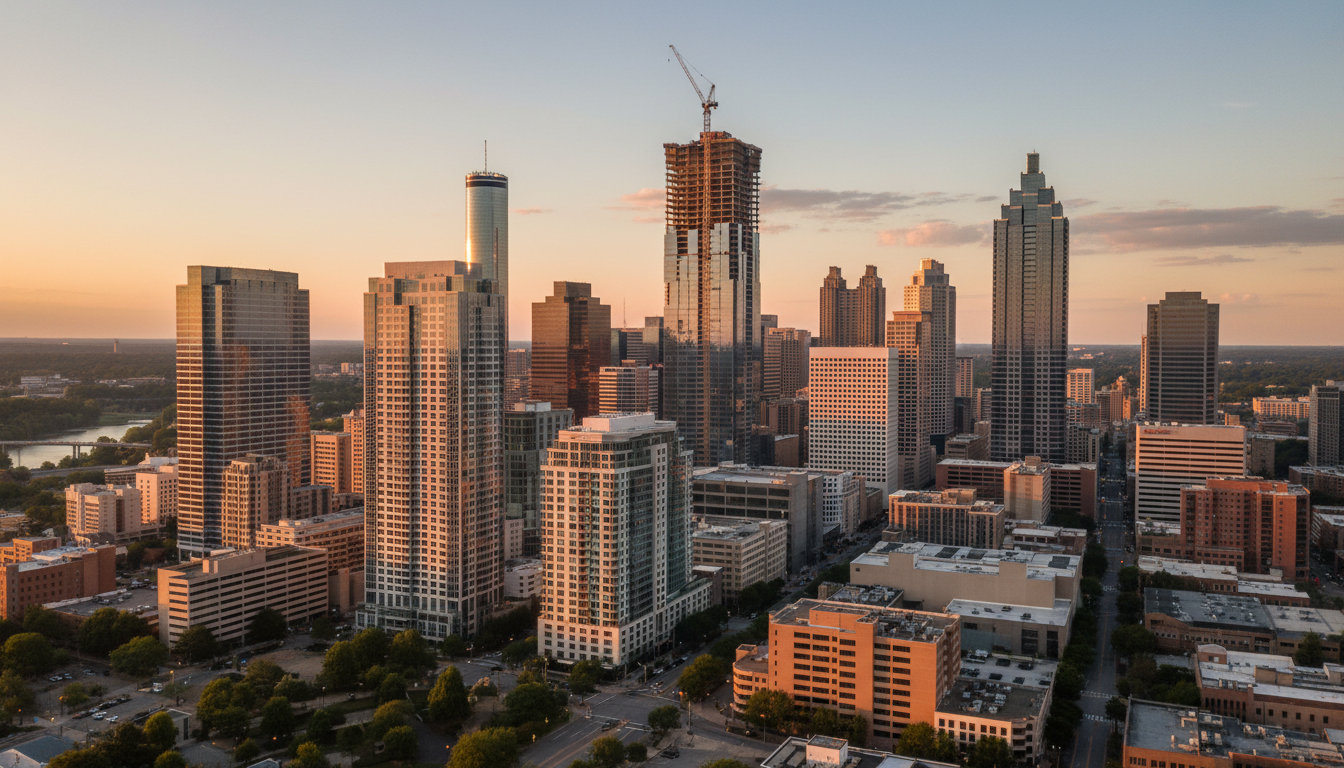
Atlanta is one of the fastest-growing metro areas in the United States, and its structural engineering landscape reflects that growth. On any given week, Atlanta’s structural engineers are stamping drawings for new high-rises in Midtown and Buckhead, rehabilitating historic properties in Inman Park and Grant Park, solving foundation problems on aging homes in Decatur, designing solar arrays on warehouse rooftops in Fulton Industrial, and supporting litigation involving construction defects on projects that were built during the boom of the early 2000s.
If you own, develop, manage, or invest in property in Atlanta, understanding how structural engineering works here — the codes, the soil, the permitting, and the specific challenges of this market — will save you time and money. This guide covers what property owners and developers actually need to know.
Three factors put Atlanta’s building stock in regular need of structural engineering services.
Metro Atlanta adds roughly 75,000 people per year. New construction in Midtown, Buckhead, West Midtown, Alpharetta, and the northern suburbs has been relentless. Every one of those projects requires structural design, and most require structural engineering support through construction administration. For anything commercial, a licensed structural PE is involved from before the permit is pulled through final inspection.
Atlanta has significant historic districts — Inman Park, Grant Park, Virginia Highland, Druid Hills, Cabbagetown, and parts of downtown. Buildings in these districts range from late-1800s wood-frame structures to early-1900s masonry buildings. Rehabilitating these structures requires engineers who understand historic materials, unreinforced masonry, and how to add modern capacity without destroying historic character. Structural rehabilitation of older Atlanta buildings is one of our most common projects.
Atlanta sits in the Piedmont region of Georgia, which means red clay — the famous Georgia red clay that turns slick in winter and hard in summer. Piedmont clay is moderately expansive and causes seasonal foundation movement in countless Atlanta homes. Most foundation settlement issues we investigate in the Atlanta metro are clay-related. See our foundation settlement guide for more.
Beyond the clay, parts of the metro have residual soils over weathered granite, and isolated areas have fill from decades of site grading that wasn’t well documented. Each of these creates different structural design considerations.
Atlanta’s structural requirements are governed by a stack of codes applied at multiple levels. Understanding which code applies to your project matters — it determines what the engineer is responsible for and what the building department will require.
Georgia adopts the International Building Code (IBC) and International Residential Code (IRC) with state-level amendments, which are published by the Georgia Department of Community Affairs (DCA). The state amendments modify specific sections of the IBC/IRC to reflect Georgia conditions and policy choices. Engineers working in Georgia have to know the current adopted edition (as of 2026, this is typically IBC 2018 or 2021 depending on the adoption cycle) and all the state amendments.
Key areas where Georgia amendments affect structural work:
The City of Atlanta’s Office of Buildings administers permits within the city limits. Other metro counties — Fulton, Gwinnett, Cobb, DeKalb, Clayton, Cherokee, Forsyth, and others — each have their own building departments with their own submittal requirements and turnaround expectations.
For a structural project in Atlanta, the typical permitting process looks like this:
Structural plan review timelines vary by jurisdiction. The City of Atlanta typically takes 2–6 weeks; some suburban counties are faster. Budget more time for complex projects.
In Atlanta and most Georgia jurisdictions, you need PE-stamped structural drawings (or calculations) for:
The rule of thumb: if your project involves anything structural on a commercial building, assume a PE is required. For residential, check with the jurisdiction — rules vary.
Our Atlanta practice covers a wide range of project types. A few of the most common:
Office, retail, restaurant, and medical tenant improvements. These projects typically involve removing or modifying non-structural partitions, adding mechanical equipment loads, punching through slabs for utilities, and occasionally modifying load paths. Even “light” tenant work often requires structural review to confirm nothing compromises the building’s existing design.
Inman Park, Grant Park, Cabbagetown, and Virginia Highland have significant stock of late-1800s to early-1900s buildings. Rehabilitating these structures means working with unreinforced masonry, old-growth wood framing, balloon framing, and foundations that predate modern soil compaction standards. It’s some of the most technically interesting work in the region — and it’s very different from designing new construction.
The City of Atlanta and surrounding counties regularly engage structural engineers for public buildings, parks structures, and infrastructure. Schools, libraries, fire stations, and community centers all require engineered design.
Fulton Industrial and the broader industrial submarkets have large-footprint warehouses with flat roofs — perfect for solar. Structural engineering for commercial solar installations is a growing part of Atlanta’s practice. Most installations require a full structural analysis and a stamped PE letter confirming the roof can carry the added load and wind uplift. See our solar PV structural engineering services for more.
Red clay foundation movement is the bread and butter of residential structural engineering in Atlanta. Old homes, new homes, commercial buildings — all are subject to clay expansion and contraction cycles. An Atlanta structural engineer evaluates these issues constantly.
Atlanta’s construction boom during the mid-2000s produced a lot of buildings — some of them built faster than they should have been. Two decades later, construction defect litigation involving those buildings is a regular part of the forensic engineering workload. Condominium projects in particular have generated substantial litigation in the metro area.
Metro Atlanta has dozens of structural engineering firms ranging from solo practitioners to 100-person multidisciplinary firms. A few criteria to consider when choosing:
1. Georgia PE licensure. Non-negotiable. Confirm the firm has at least one engineer licensed in Georgia. For multi-state projects, confirm licensure in each state.
2. Relevant project experience. An engineer who designs warehouses may not be the right choice for a historic rehabilitation. Ask for recent comparable projects.
3. Local code fluency. Experience with City of Atlanta and surrounding counties shortens the permit review cycle because the engineer already knows what each department wants.
4. Insurance. Professional liability (errors & omissions) insurance should be in place. For significant projects, the owner should verify coverage limits.
5. Communication style. Structural engineering involves architects, contractors, owners, and sometimes attorneys — many of whom are not technical. Look for an engineer who explains things clearly.
6. Multi-disciplinary capability. For complex projects, a firm that handles structural plus forensic, solar, and expert witness work can often solve problems that a single-specialty firm would have to refer out.
Strut Engineering & Investment is headquartered in Atlanta and provides structural engineering services across the metro area and beyond. Our Atlanta practice includes:
Our engineers are licensed in 28+ states, which matters for multi-state projects and litigation that crosses jurisdictions. Learn more about our full Atlanta service area.
How much does a structural engineer cost in Atlanta?
Atlanta structural engineering fees depend heavily on the scope of work, the complexity of the project, the deliverable required (letter, sealed drawings, stamped calculations), and whether construction administration is included. A simple PE letter is a very different engagement than a full commercial structural design. See our full cost guide for a breakdown of what drives structural engineering fees.
Do I need a structural engineer for a renovation in Atlanta?
It depends on the scope. Removing load-bearing walls, adding a second story, modifying the foundation, or any work that exceeds IRC prescriptive limits requires a licensed PE. Cosmetic renovations typically do not. When in doubt, check with the permitting jurisdiction.
How do I find a licensed structural engineer in Atlanta?
Check the Georgia Professional Licensing Boards to verify PE licensure. Ask for references from recent comparable projects. Verify insurance. Get multiple quotes to compare scope (not just price).
What building codes apply to structural work in Atlanta?
Atlanta follows the International Building Code (IBC) and International Residential Code (IRC) as adopted by Georgia with state amendments. ASCE 7 governs structural loads. Some historic districts have additional overlay requirements. The specific code edition varies by jurisdiction and by year of adoption.
Does Atlanta require PE stamps on structural drawings?
Yes, for almost all commercial structural work and for residential work that exceeds the IRC prescriptive design limits. Solar installations typically require PE letters. Historic district work may have additional stamping requirements.
How long does the structural permitting process take in Atlanta?
City of Atlanta structural plan review typically runs 2–6 weeks for a standard commercial project. Surrounding metro counties range from 1 to 4 weeks. Complex projects or projects with multiple review comments can extend significantly. Good engineering drawings — clear, code-compliant, and complete — dramatically shorten the review cycle.
What areas of metro Atlanta does Strut E&I serve?
Strut E&I serves all of metro Atlanta including the City of Atlanta, Sandy Springs, Roswell, Alpharetta, Marietta, Johns Creek, Decatur, Smyrna, Dunwoody, Brookhaven, Kennesaw, Woodstock, Cumming, Peachtree Corners, and surrounding areas across Fulton, Gwinnett, Cobb, DeKalb, Cherokee, and Forsyth counties. We also serve Savannah and other Georgia markets.
Looking for a structural engineer in Atlanta? Strut E&I is headquartered in Atlanta and serves clients across the metro area with structural design, rehabilitation, forensic engineering, solar PV, expert witness, and PCA services. Contact our Atlanta team for a consultation on your project.